Whistleblowing in the UAE, Saudi Arabia, and Qatar: Is your program ready?
Legal & Compliance

Alaa El-Shaarawi
Copywriter and Content Manager
Published on
Reading time
9 min
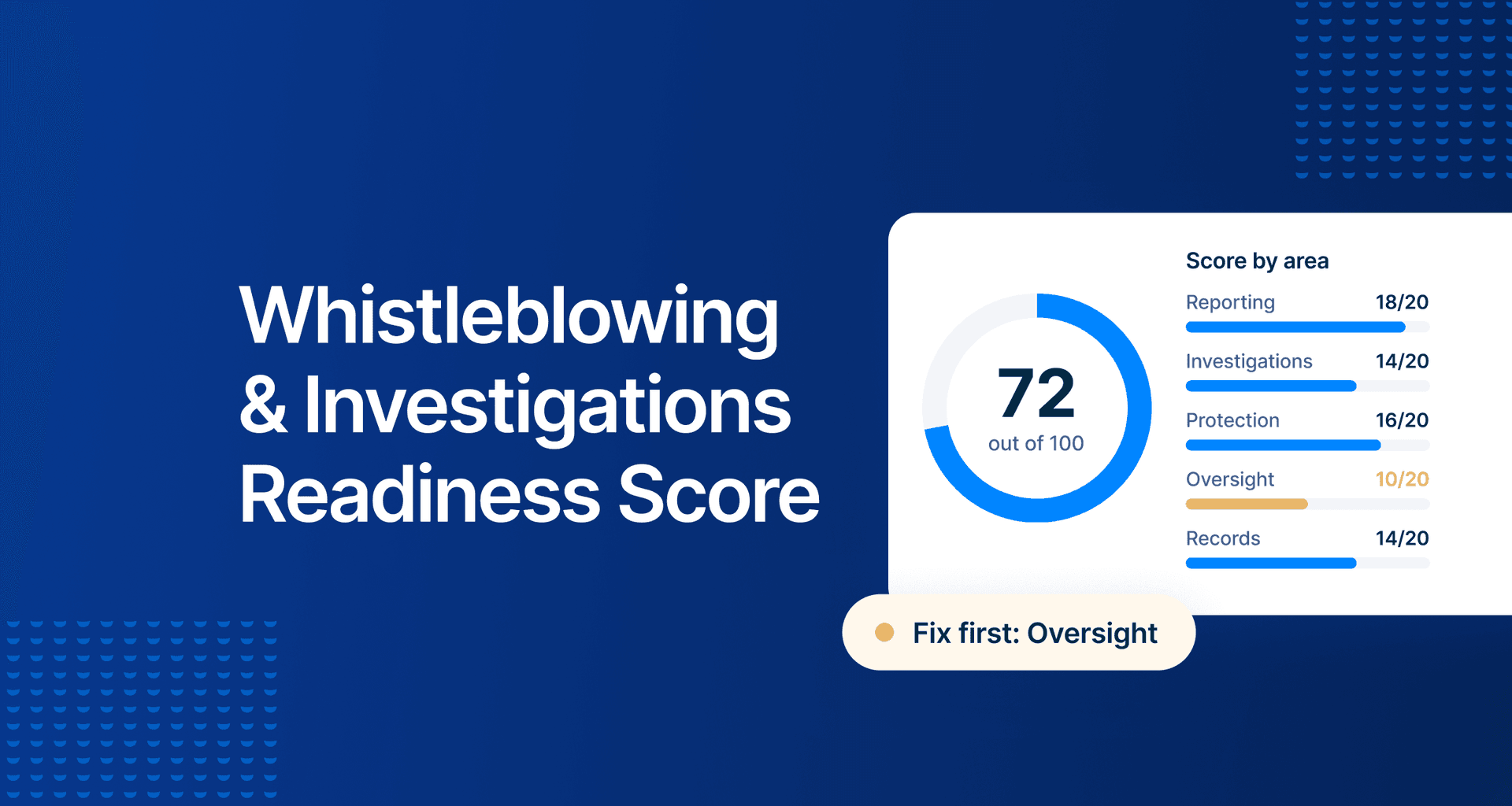

Table of contents
Subscribe to our newsletter

Whistleblowing in the UAE, Saudi Arabia, and Qatar: Is your program ready?
Regulators across the Gulf have moved past asking whether you have a whistleblowing policy. They want to see that people use your reporting channel, that reports are investigated properly, and that the people who speak up stay safe.
As Manish Bucha, Managing Partner at UAE risk advisory firm S&B Consulting and formerly of PwC and KPMG, said in a FaceUp webinar, “Regulators are clearly saying: show us that your systems actually work.”
That’s a harder test than having a document on file. This guide covers what the rules in the UAE, Saudi Arabia, and Qatar expect, the five areas that decide whether a program holds up, and how to score your own in 15 minutes.
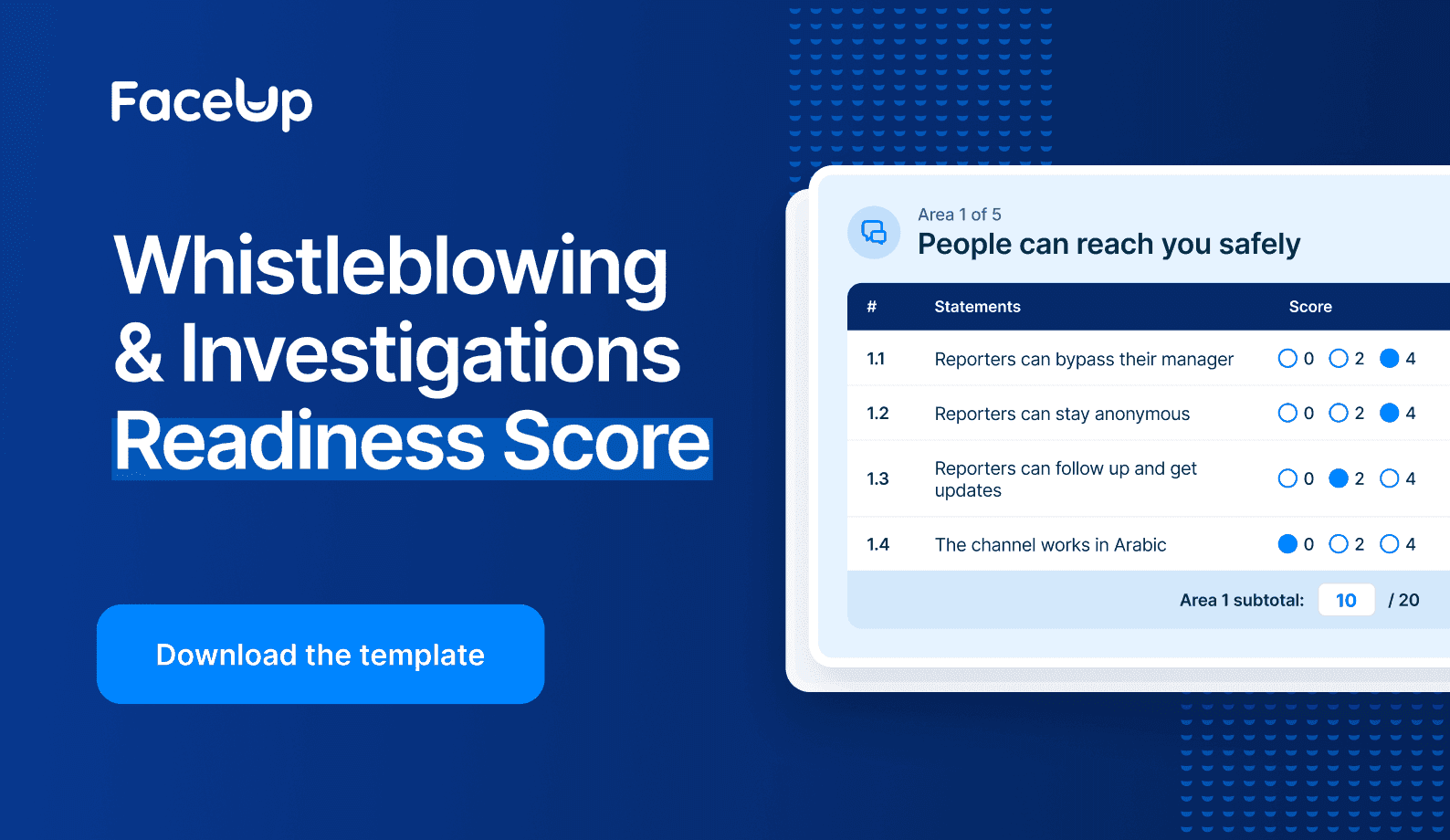
Want to go straight to scoring? Download the free Whistleblowing & Investigations Readiness Score.
The rules differ by country, and even inside the UAE
There’s no single GCC whistleblowing law. The UAE alone has three regimes: the mainland, and two financial free zones with their own courts and regulators. Saudi Arabia regulates by sector. Qatar has no standalone whistleblowing law, but the Qatar Financial Centre has its own rules.
ADGM (Abu Dhabi)
- Main rules: Whistleblower Protection Regulations 2024, in force since 5 July 2024, with arrangements due by 31 May 2025.
- Who they cover: All ADGM establishments. Written policies for Authorised Persons, Recognised Bodies, DNFBPs, DLT Foundations, and Large Establishments (over USD 13.5M turnover or assets and over 35 employees).
- What they expect: Arrangements to receive, assess, and escalate disclosures, protection of the reporter’s identity, and records kept at least six years after a matter closes.
DIFC (Dubai)
- Main rules: DIFC Regulatory Law, Article 68A, and DFSA rules, in force since 7 April 2022.
- Who they cover: DFSA Authorised Persons, registered auditors, and DNFBPs.
- What they expect: Confidential reporting routes and protection from retaliation. Whistleblowers can apply to the DIFC Courts for relief.
UAE mainland
- Main rules: Federal Decree-Law No. 33 of 2021 and Cabinet Resolution No. 1 of 2022.
- Who they cover: Private-sector employers.
- What they expect: No dedicated whistleblowing law. Employers with 50+ workers must publish a complaints and grievance system. Strict disciplinary deadlines. Articles 4 and 14 prohibit discrimination and harassment.
Saudi Arabia (financial sector)
- Main rules: SAMA Whistle Blowing Policy for Financial Institutions, 2019.
- Who they cover: Banks, insurers, and other SAMA-supervised institutions.
- What they expect: A board-approved policy, an independent unit for reports, at least phone, website, post, and email channels, and protection from retaliation.
Saudi Arabia (all sectors)
- Main rules: Law on the Protection of Whistleblowers, Witnesses, Experts and Victims, in force since June 2024.
- Who they cover: People who report crimes to the authorities.
- What they expect: A protection program run under the Public Prosecution, plus protection against dismissal, with reinstatement and compensation as remedies.
Qatar
- Main rules: QFC Employment Regulations and QFCA Whistleblowing Reporting Guidelines, QFMA Governance Code for Listed Companies 2025, and Law No. 13 of 2016 on personal data (PDPPL).
- Who they cover: QFC firms, listed companies, and anyone processing personal data.
- What they expect: In the QFC, reporting channels and protection from dismissal for good-faith reporters. Board-level governance for listed companies. Permission before processing sensitive data, with fines up to QAR 5 million.
One practical rule follows. If you operate in more than one of these, build to the strictest framework that applies to you. A group with an ADGM entity and a Riyadh bank subsidiary can’t run two standards of care.
For the details, see our guides to the ADGM Whistleblower Protection Regulations, DIFC whistleblowing regime, QFCRA whistleblowing rules, and Qatar’s PDPPL. This overview is general information, not legal advice.
Five areas decide whether your program holds up
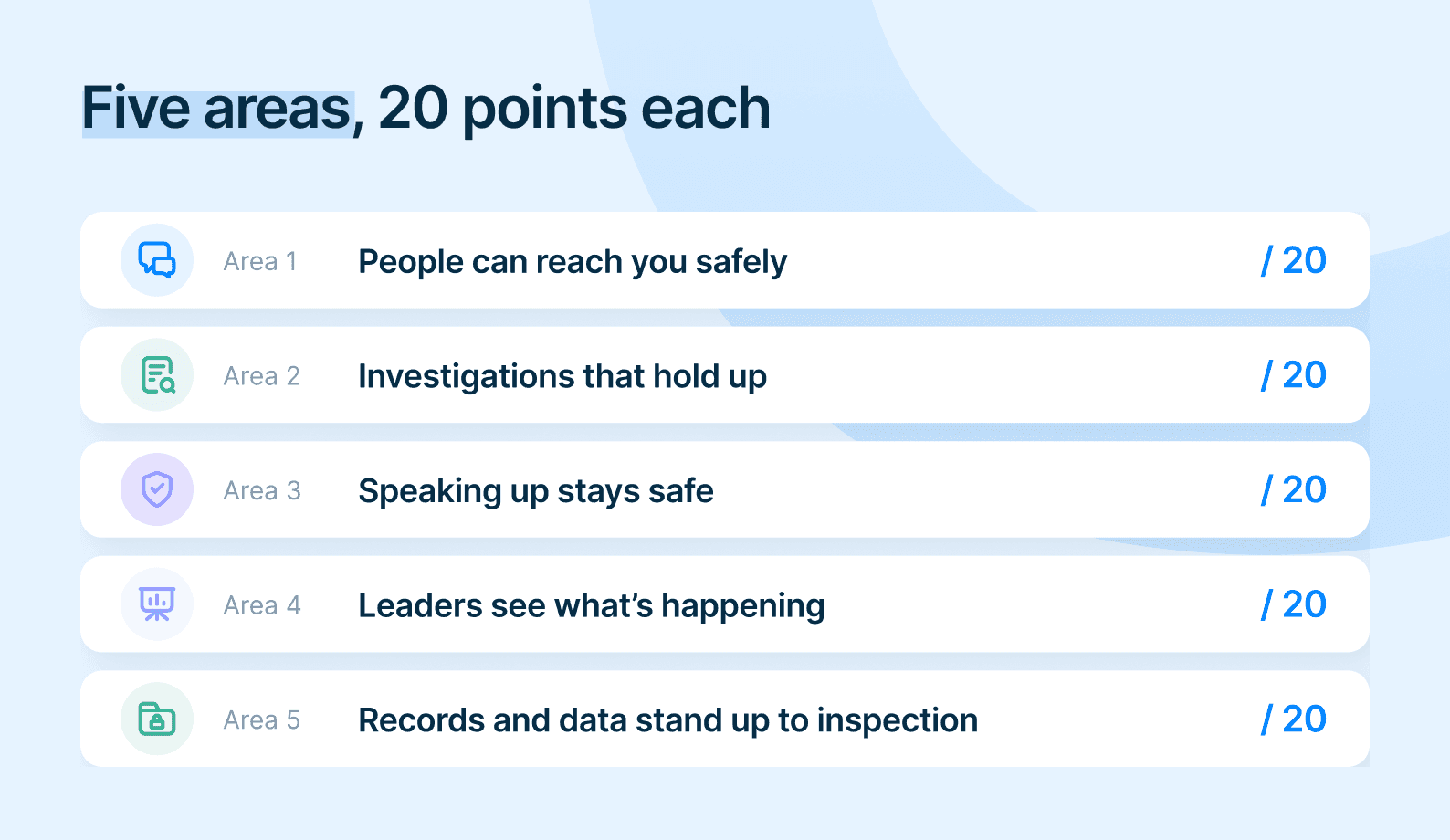
These come from FaceUp webinars with employment lawyers at Gateley Middle East and governance advisers at S&B Consulting, and from the rules above. Each is an area in the Readiness Score. They’re good practice wherever you operate, even where the law doesn’t yet require them.
1. People can reach you safely
Most employees won’t report if they don’t know where to go, and the hardest case is a concern about their own line manager. Gateley Middle East named this as one of the most common gaps they see: people simply don’t know who to tell.
A channel that works in the region does four things. It lets people report around their management line, including about senior leaders. It lets reporters stay anonymous if they choose, and keeps that anonymity through follow-up questions.
It works in the languages your workforce uses, Arabic included. And it reaches people without a desk: frontline staff, contractors, and supplier workers who don’t have a company login.
The law points the same way. On the UAE mainland, employers with 50 or more workers must publish a complaints and grievance system that workers can access.
SAMA expects financial institutions to offer at least a phone line, a website, post, and email. In Qatar, the QFC’s whistleblowing guidelines set out reporting channels for fraud, corruption, and other misconduct.
Two questions from the Readiness Score to try now: can someone report a concern about their own manager without going through them? Can a site worker report without a company email address?
2. Investigations that hold up
On the UAE mainland, timing can decide a case before anyone looks at the evidence. Under Cabinet Resolution No. 1 of 2022, an employee can’t be accused of a violation discovered more than 30 days earlier, and no penalty can be imposed more than 60 days after the investigation ends.
Saudi Arabia’s window is tighter: Article 69 of the Labor Law allows 30 days from discovery to charge, and 30 days after the investigation to penalise. In Qatar, the employer has 15 days from becoming aware of a breach to charge the employee, unless the breach is a criminal offence.
In all three countries, the employee must also be told of the allegation and questioned before any penalty. In the UAE and Saudi Arabia, their statement and defence must be recorded in writing.
Gateley’s lawyers stressed three more points from their casework. Secure evidence before the subject learns of the investigation, because data deletion is common once they do, and include WhatsApp and Teams, not only email.
Write the allegation precisely and link it to the policy or legal ground it relates to, such as the dismissal grounds in Article 44 of the Labour Law; vague allegations make a termination hard to defend later. And give the case to an investigator with no involvement in the underlying issue.
Read more in our guide to workplace investigations in the UAE.
3. Speaking up stays safe
Every framework above protects good-faith reporters in some way. ADGM’s regulations protect them from dismissal and other detriment. In the DIFC, a whistleblower who suffers retaliation can apply to the DIFC Courts, which have broad discretion to grant relief, including compensation.
On the mainland, Article 47 of the Labour Law protects employees who file a serious complaint with the Ministry of Human Resources and Emiratisation. In Saudi Arabia, the 2024 whistleblower protection law guards against dismissal and other retaliation, with reinstatement and compensation as remedies. In Qatar, QFC rules protect good-faith reporters from dismissal and other penalties.
The legal risk is only half of it. When employees see a colleague sidelined after reporting, they stop reporting. Strong programs make retaliation a disciplinary offence in the policy, limit the reporter’s identity to named case handlers, and check what happens to reporters afterwards: reviews, pay, transfers, and exits.
4. Leaders see what’s happening
S&B Consulting’s view is blunt: tone at the top matters more than policy. People speak up when they see leaders take reports seriously and act on them.
That needs a named senior owner and regular reporting to the board. SAMA already expects financial institutions to report periodically to the board and audit committee on whistleblowing.
It also means reading silence correctly. A long stretch with no reports isn’t a sign that nothing is wrong. As Manish Bucha put it, silence is a risk indicator, not a success metric. Over time, healthy programs often see fewer reports because issues get resolved earlier, not because people stop speaking.
5. Records and data stand up to inspection
Reports hold some of the most sensitive data an organisation keeps: health details, allegations of crime, names of witnesses. ADGM requires records of each disclosure, the supporting documents, and the findings to be kept for at least six years after the matter closes.
Data protection adds a second layer. The UAE, Saudi Arabia, and Qatar each have their own data protection law, and ADGM and DIFC have theirs.
In Qatar, personal data of a special nature, including health and criminal records, can only be processed with prior permission, and the most serious breaches of the law carry fines of up to QAR 5 million. Qatar’s guidance also sets a 72-hour window to notify a serious data breach.
Know where your report data is hosted, document any cross-border transfers, and test your breach plan.
How to score your program in 15 minutes
The Readiness Score turns these five areas into 25 short statements, five per area. Get your HR, legal, and compliance leads in a room and score each one:
- 0 if it isn’t in place
- 2 if it’s partly in place
- 4 if it’s in place and you could show evidence to a regulator today
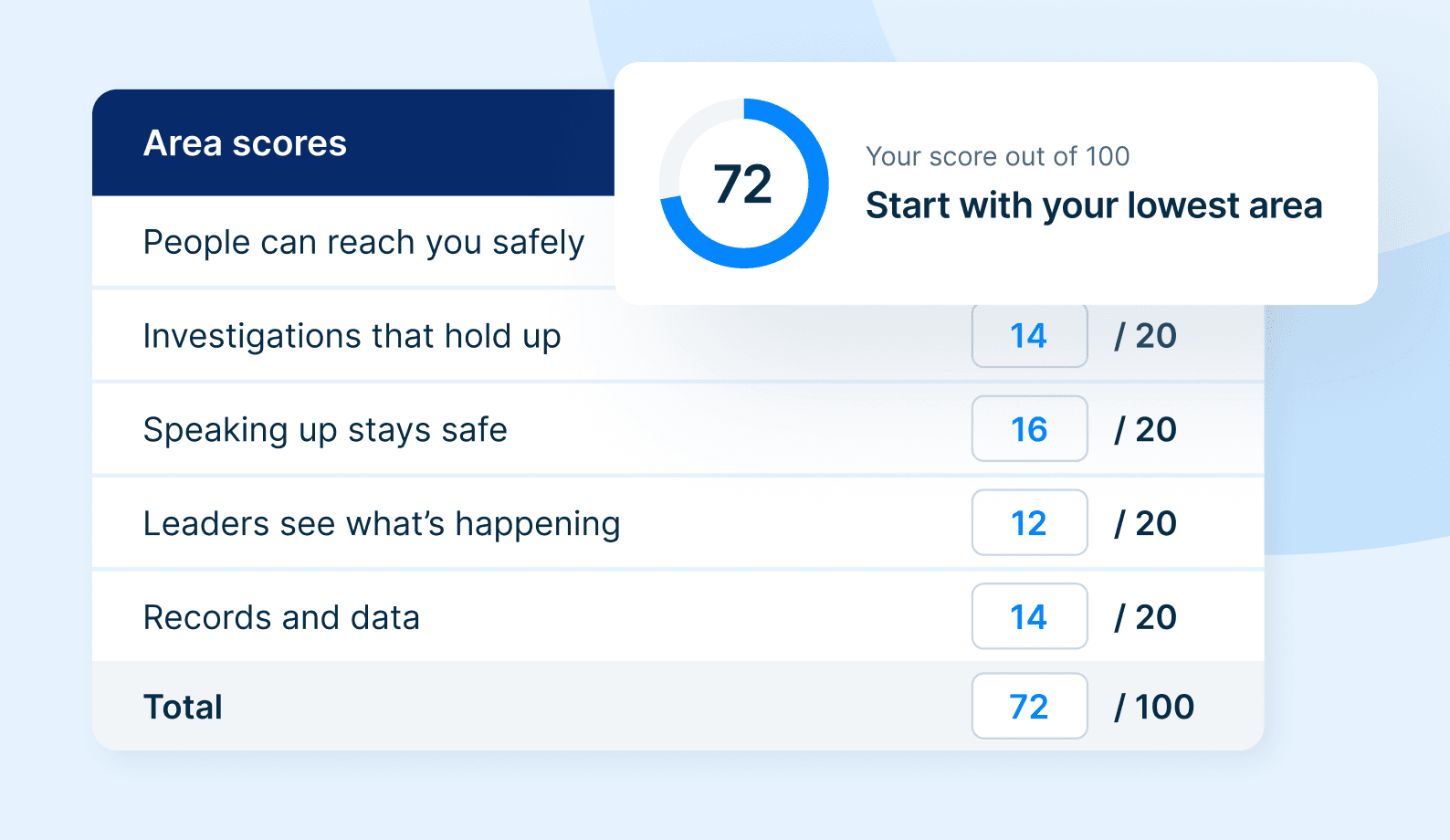
Be strict about evidence. A policy that says something happens isn’t proof that it does. If you couldn’t produce the record, score it 2 at most.
Each area is worth 20 points, so the total is out of 100. The total tells you where you stand overall. The area scores tell you where to start, and they matter more: a strong total can hide one area that would fail an inspection.
The template includes all 25 statements, the legal basis behind each area, where there is one, examples of evidence you could show for each area, a score sheet, the three bands with what each means, and the first three moves for whichever area scores lowest.
What the first 90 days can look like
Whatever your score, a quarter is enough to move it.
Days 1 to 30: get the legal basics right. Map which framework applies to each entity and name an owner. Start tracking each country’s disciplinary deadlines on every open case. Add an explicit no-retaliation clause to your policy.
Days 31 to 60: fix the channel and the process. Add anonymous follow-up, Arabic, and access for frontline workers and contractors. Write a standard investigation process with an evidence-hold step. Check where report data is hosted.
Days 61 to 90: build trust and oversight. Train line managers and investigators. Relaunch the channel with a message from leadership. Start regular board reporting on cases and trends.
Then score again, and show your board the change in one number.
Get your score
Gulf regulators will keep asking for proof. The quickest way to see what you can prove today is to score yourself. The Whistleblowing & Investigations Readiness Score takes you through 25 statements and gives you one score out of 100, plus your first moves.
Want to see how teams run reporting, investigations, and records across entities and countries in one platform? Book a demo.
This article is general information, not legal advice. It covers the UAE (mainland, ADGM, and DIFC), Saudi Arabia, and Qatar. Check local requirements with counsel.
Keep Reading
Alaa El-Shaarawi2026-11-026 min
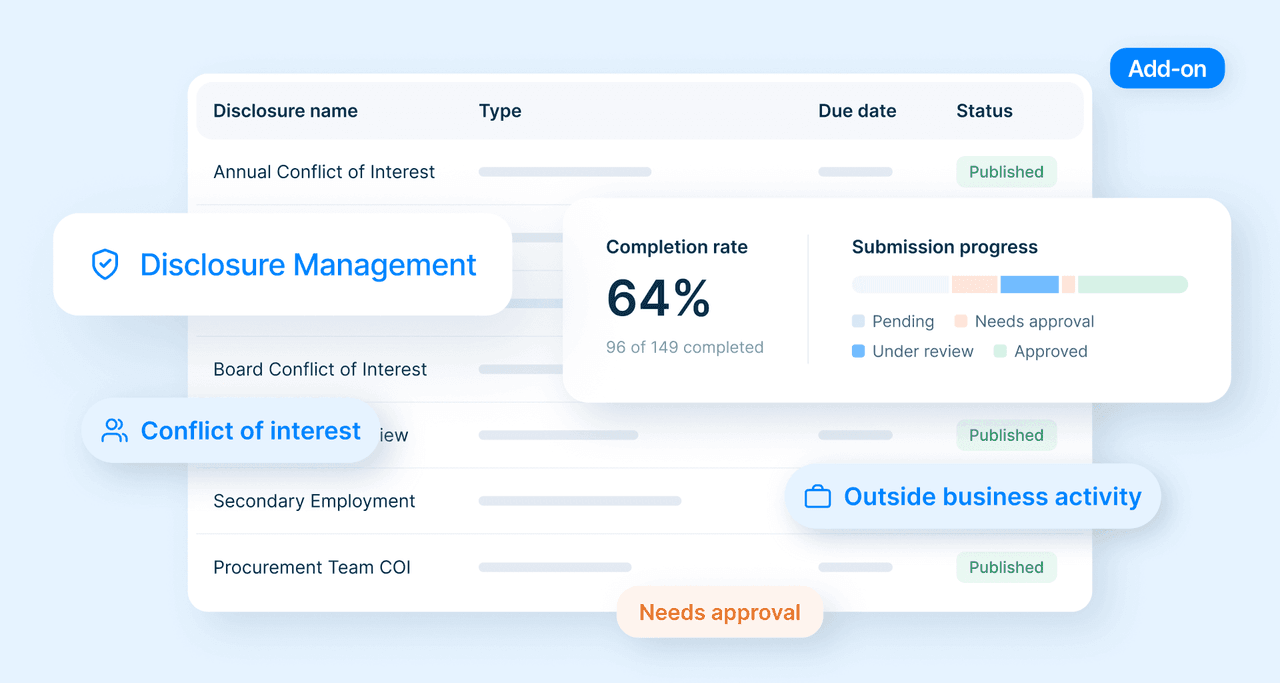
Introducing Disclosure Management: every employee declaration, tracked in FaceUp
Legal & Compliance
Alaa El-Shaarawi2026-10-0510 min
Gulf construction safety: Why on-site hazard reporting keeps breaking
Legal & Compliance
Alaa El-Shaarawi2026-10-028 min
UAE whistleblowing: The biggest programs are being built where no law requires them
Legal & Compliance
Alaa El-Shaarawi2026-09-249 min
EU AI Act Whistleblowing: What Changed on August 2, 2026
Legal & Compliance