Gulf construction safety: Why on-site hazard reporting keeps breaking
Legal & Compliance

Alaa El-Shaarawi
Copywriter and Content Manager
Published
2026-10-05
Reading time
10 min

Table of contents
Subscribe to our newsletter

Gulf construction safety: Why on-site hazard reporting keeps breaking
On most Gulf construction sites, the rule for reporting a hazard is simple: tell your supervisor.
Abu Dhabi's occupational safety framework says this directly. Under Element 1, a worker must "report to their immediate supervisor any situation which they have reason to believe could present a hazard."
For most hazards, this works well. The supervisor is close by and can fix the problem quickly.
But some hazards are different. Inspections and daily safety talks catch most problems. The ones that remain are often the ones the supervisor would rather not see: a shortcut they approved, a deadline they're under pressure to meet, or the way they treat their crew. In these cases, the rule sends the worker to the one person least likely to act.
This problem exists on any site. On large Gulf projects it's bigger, for two reasons. Most workers are employed through contractors, and many are far from home. And a single site usually follows three sets of rules at once:
- national safety law
- the client's health, safety and environment (HSE) standards
- on a financed project, the lender's requirements
These rules don't agree. The first sends workers to their supervisor. The third requires a way to report that goes around the employer, anonymously if the worker prefers.
If you lead HSE or compliance for a project owner or a main contractor, this gap can cost you in two ways. On site, it's the accident the crew saw coming but nobody reported. In a client or lender review, it's a reporting process that looks fine on paper but doesn't meet the lender's standard.
Rulebook one: UAE and Saudi safety law
In the UAE, Federal Decree-Law No. 33 of 2021 sets the basic duties for employers. They must provide a safe workplace, protective equipment and regular medical checks. Outdoor work in direct sun is banned from 12:30 to 15:00 between 15 June and 15 September.
There are reporting duties too. Employers must report any work injury or death to MoHRE within 48 hours. Sites with 50 or more workers need a system to track injuries and work-related illness. Industrial and construction companies with 100 or more employees need a qualified health and safety officer.
In Abu Dhabi, companies also follow the framework mentioned above. Element 4 says employees should take part in safety decisions, including risk assessments and incident investigations. Element 3 makes companies responsible for contractors' workers, not only their own staff.
Saudi Arabia's Labor Law is similar. Employers must explain job hazards before work starts, provide protective equipment and training, and can't take the cost out of wages. Safety instructions must be posted in Arabic and, where needed, in other languages the workers understand.
Saudi workers also have the right to walk away. If they face serious danger that the employer knew about and didn't fix, they can leave the job without notice and keep their legal rights.
Notice what these rules have in common. Most of them only start once the company already knows about a problem. Injury reporting starts after someone is hurt. A safety officer can only act on what they hear about. And the right to walk away puts all the pressure on one worker, alone, in a dangerous moment.
The rule on language shows the gap clearly. The law makes sure safety information reaches workers in their language. It says nothing about how workers send their concerns back.
Rulebook two: client HSE standards and the contractor chain
On big projects, the project owner usually sets its own HSE standards, and they're often stricter than the law. These standards are passed down to every contractor through tender questionnaires, contract terms and audits.
A contractor bidding for work with a national oil company or a government developer has to answer more questions than the law asks. One question comes up more and more often: how can workers raise concerns, and what happens next?
Here's the problem. The worker who spots a hazard may be employed by a labour supplier, which works for a subcontractor, which works for a main contractor, which works for the client. Each company may have its own reporting channel, or none at all.
If a report stops at the worker's direct employer, it stops with the company that has the most to lose if the report is true. To reach the client who set the standard, a concern has to pass through three other companies first.
Rulebook three: lender requirements under IFC Performance Standard 2
This set of rules asks the most about reporting, but it's rarely discussed in site safety meetings. It also fits a pattern we've seen across the region: in the Gulf, pressure to set up a formal reporting channel usually comes from investors, lenders and partners before it comes from regulators.
The International Finance Corporation (IFC) is the part of the World Bank Group that lends to private companies. Its Performance Standard 2 (PS2) sets rules for workers' rights and working conditions. It applies to projects the IFC finances, and to projects financed by banks that follow the Equator Principles. If either is funding your project, PS2 applies to you.
Paragraph 20 sets out what workers need. The company must provide "a grievance mechanism", meaning a formal way for workers to raise concerns. Workers must be told about it when they're hired. Concerns must be handled through "an understandable and transparent process that provides timely feedback", "without any retribution". And the mechanism "should also allow for anonymous complaints to be raised and addressed".
Paragraph 26 covers workers hired through contractors. They must have a way to raise concerns too. If their employer can't provide one, the company running the project must let them use its own.
Put this next to Abu Dhabi's Element 1 and the conflict is clear. One rule sends workers to their supervisor. The other requires an anonymous route that goes around the employer completely.
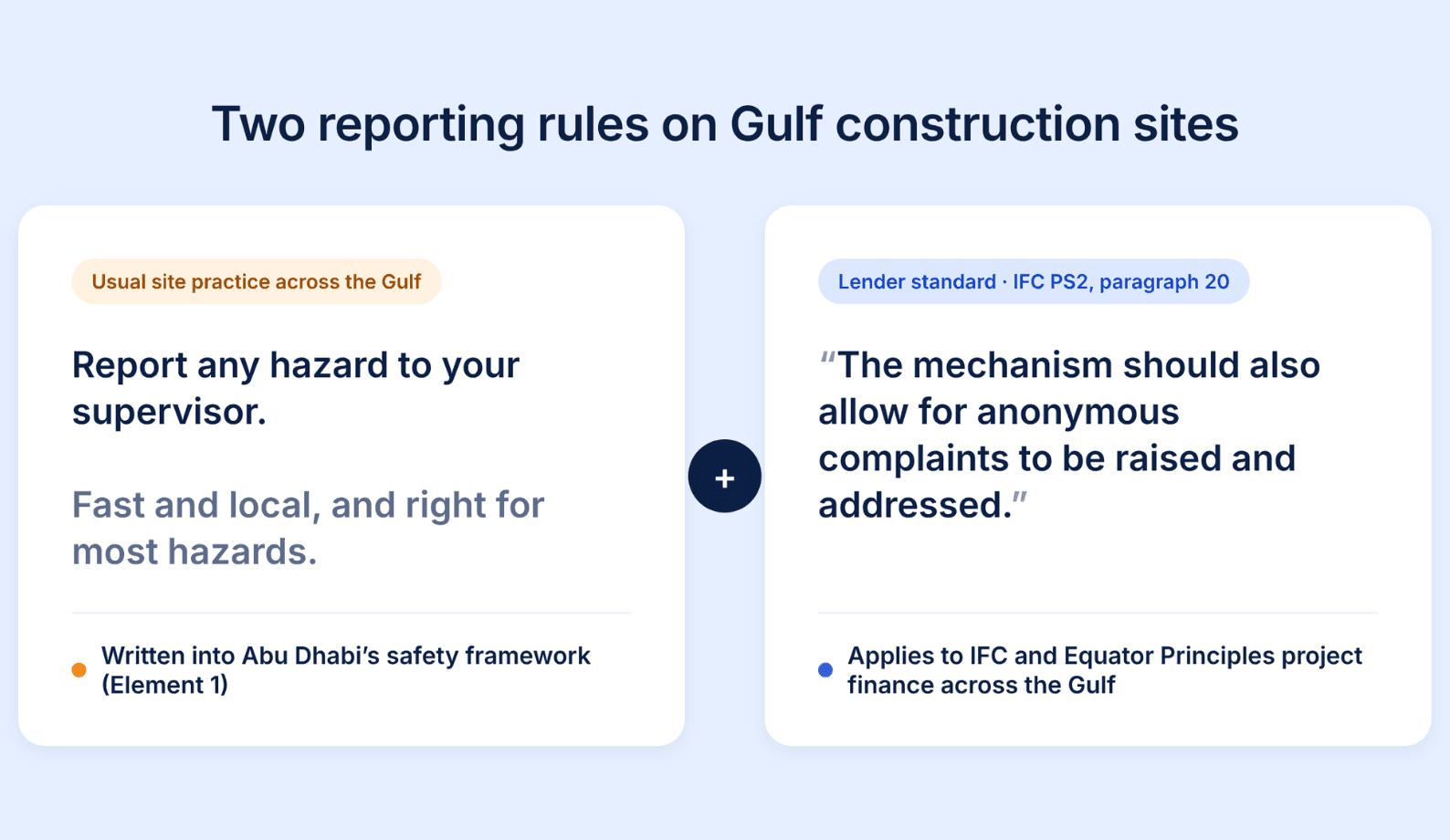
Large financed projects in the Gulf must follow both. In practice, companies follow the first, because it's in the induction pack and the audit checklist. They assume they meet the second, because they have a suggestion box and an HR email address. Those can look like a grievance mechanism, until someone checks them against paragraph 20.
Four reasons workers don't report hazards
Even when the rules are right, four things stop a report from reaching someone who can act on it.
No company email. Most site workers don't have one. A system that needs a company login or a desktop computer doesn't reach them.
Many languages. One site can use Hindi, Urdu, Bengali, Malayalam, Tagalog, Arabic and English. Studies of migrant construction workers, in the Gulf and in Europe, find the same thing: language and literacy gaps block safety communication in both directions. The workers most at risk are the least likely to use a written channel in a second language.
Fear for their visa. A worker's job is often tied to their visa and their right to live in the country. Reporting an unsafe practice can feel like risking both. That's why PS2 requires anonymity and protection from retaliation.
No paper trail. The reports that could prevent an accident aren't recorded anywhere: a near miss, a shortcut under deadline pressure, scaffolding that moved overnight, a generator nobody has serviced. The crew knows about them. The company's records don't.
Why a safety-only channel isn't enough
You might think a dedicated safety hotline would solve this. But workers don't sort their concerns into categories before they report. They just report what's wrong.
When a channel is open to everyone, safety concerns arrive with many other issues: broken equipment, missing guards, heat exposure outside the legal hours, tiredness from long shifts, poor housing and transport, and supervisors pushing people to keep working.
Workers also report recruitment fees and unpaid wages. These matter because they're exactly the issues clients and lenders check under PS2. Harassment and bullying reports come in too, often from people who've had nowhere else to go.
So one channel needs to receive everything and send each report to the right person. That's simpler than running a safety hotline, an ethics line and a welfare desk side by side.
What a construction site reporting channel needs
The channel has to meet the lender's standard on paper and work for real workers on a real site. That gives you this list.
No login needed. Put a QR code on site posters, fences, rest areas or the back of ID cards. It should open on a personal phone, with no app to install and no company account. PS2 says workers must learn about the channel when they're hired, so add it to the induction.
In workers' own languages. Use the languages the crew speaks, not only the language of the contract.
Voice as well as text. Not everyone reads and writes comfortably. Many workers who won't fill in a form will make a phone call.
Anonymous from start to finish. Anonymity has to last beyond the first report. Investigators will need to ask follow-up questions, like which site, which shift or which machine. The worker should be able to answer without giving their name.
Sent past the person involved. Reports about a manager, and reports about injuries or safety stoppages, should go to HSE leadership or a committee, not the site office. Under PS2 paragraph 26, the main contractor's channel should also be open to workers employed by other companies.
Quick feedback. PS2 requires it. If a worker reports something and hears nothing back, they'll tell the crew the channel doesn't work. Winning back that trust is much harder than earning it the first time.
One record across all sites. If 15 sites each send reports to a different inbox, nobody sees the pattern. The same missing guard at four sites points to a purchasing decision, not four separate incidents.
Where FaceUp fits
We built FaceUp around this list, and the Gulf is one of the hardest places to meet it: many languages on one site, workers without company email, and reports that have to go past the people they're about.
FaceUp is an ethics and compliance platform used by organisations in more than 70 countries, including Gulf energy and industrial companies such as Sharjah National Oil Corporation. Here's how it meets each need.
Reporting without a company account. Workers can report by QR code, mobile form or web link, with no company email needed, in 113 languages, including Arabic. Hotline services, AI or automated, are available as add-ons for workers who prefer to speak.
Anonymity during the investigation. Workers can stay anonymous and still message the case handler through a secure chat. This helps you meet PS2's anonymity requirement and still complete a proper investigation.
Reports go to the right people. You choose who sees each report, so a complaint about a site manager doesn't go to that manager. Reports can go to HSE, HR, a committee or an outside party. Contractors' workers can use the channel too.
Feedback workers can see. Workers can check the status of their report and read replies in the same secure chat. This shows the crew that reports lead somewhere.
One record for every report. Every report becomes a case with an owner, a status and a full history, across all your sites. That's what you show an auditor, a client's HSE team or a lender.
Data stored in the UAE. Clients and lenders often ask where report data is kept. FaceUp can store data in the UAE. We're ISO 27001:2022 certified, and our controls are aligned to the SOC 2 Trust Services Criteria.
Safety reports sit on the same platform as conduct and integrity reports from construction and manufacturing sites, because workers report everything together.
Getting hazard reports to the person who can fix them
Three sets of rules apply to the same site, and all three leave the same gap. National law requires a safe workplace. The client sets its own safety standards. The lender expects a way to raise concerns anonymously, without retaliation. None of them makes sure a hazard reaches the person who can fix it.
Your workers already know where the risks are. The question is whether they have a safe way to tell someone other than the person the report is about.
Book a demo and we'll follow one report from start to finish. A worker scans the QR code on site and reports a hazard anonymously from their phone. You'll see how the report reaches the right person and becomes a case, how it gets resolved, and how to set this up across all your sites.

Keep Reading
Alaa El-Shaarawi2026-10-028 min
UAE whistleblowing: The biggest programs are being built where no law requires them
Legal & Compliance
Alaa El-Shaarawi2026-09-249 min
EU AI Act Whistleblowing: What Changed on August 2, 2026
Legal & Compliance
Alaa El-Shaarawi2026-09-095 min
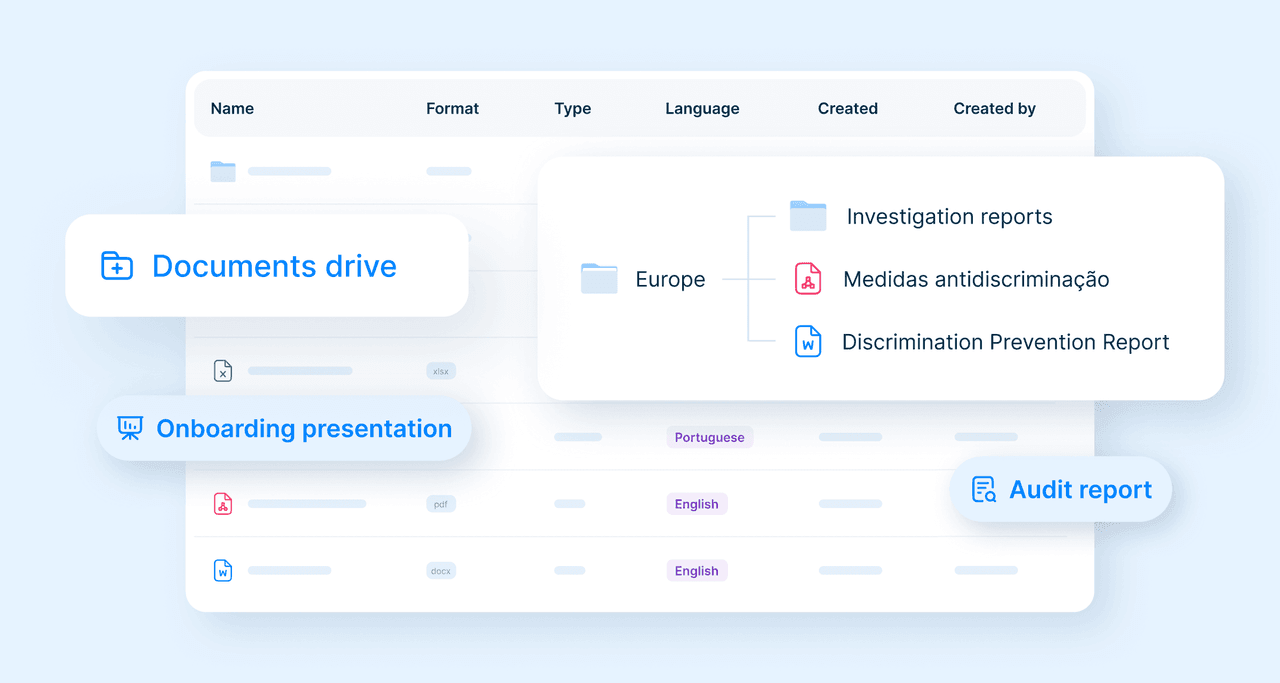
Introducing Documents: Your Own Compliance Library in FaceUp
Legal & Compliance
Mary Shirley2026-07-285 min
Three Warning Signs Your Speak-Up Program Needs an Upgrade, and What to Do About It
Workplace Environment