Disclosure Management
Employees declare conflicts, gifts, and outside activities on forms you send. You see who’s pending and review each one.
See how disclosures workDisclosure management
Build declaration forms around your policy and send them to the right people. See who still owes one, then review and approve each declaration, with your reasoning on record.
RUN BY COMPLIANCE TEAMS WORLDWIDE


A declaration nobody reviews doesn't manage the conflict. The employee describes their interest, and your team decides whether it matters and what happens next, on a record anyone can follow.

Most conflicts are simple to resolve when declared early. Left undeclared, they come back later as reports.

One review process for every team, so no one gets a stricter or softer hearing for the same conflict.

Every answer, reviewer, and decision note stays with the declaration, so you can back up any decision later.
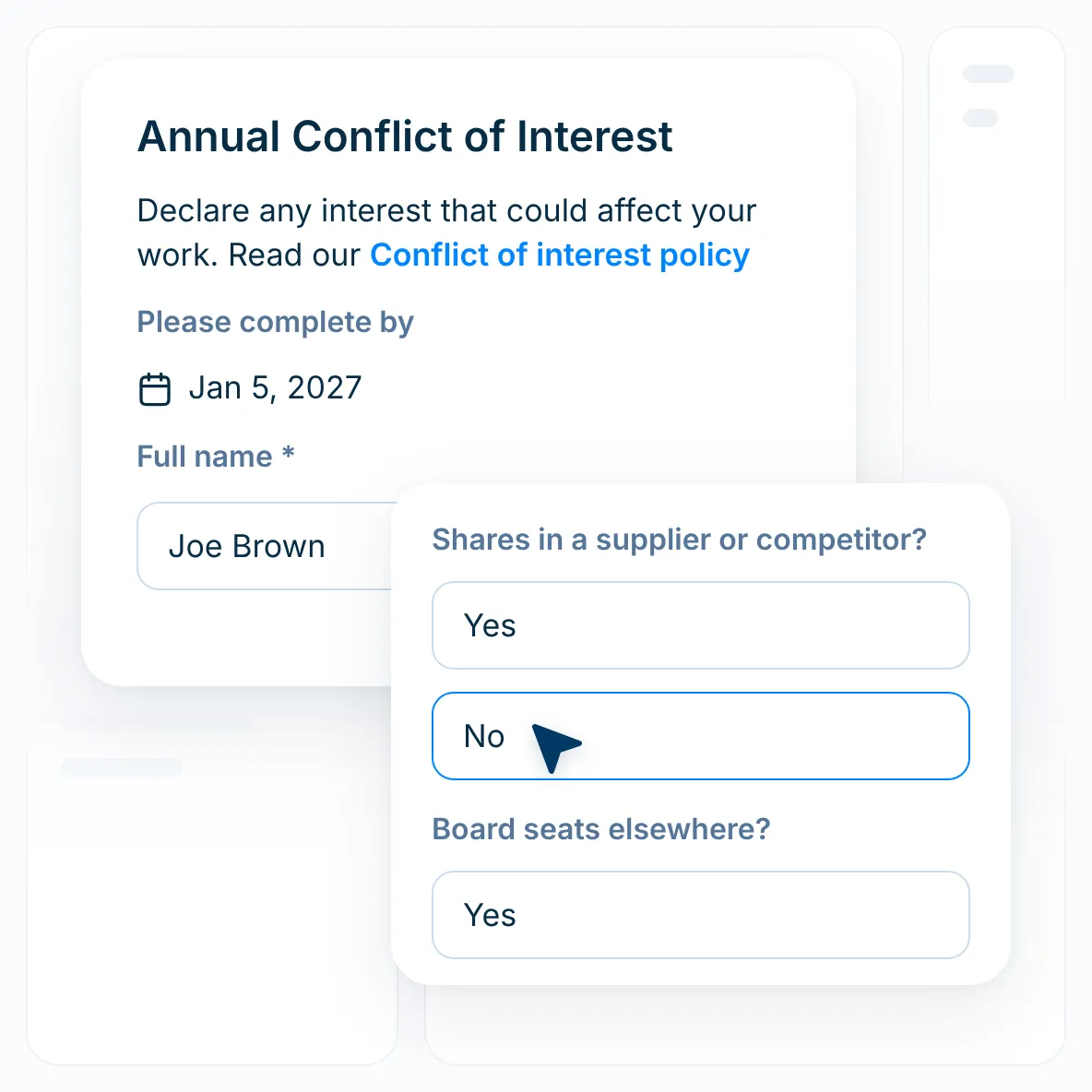
In Disclosure Management, write the questions and the guidance employees see, with AI to help you draft them, then choose how each form reaches people.

Ask about shareholdings, family ties, and board seats, with your policy shown above the questions
Invite new starters or everyone due for the annual refresh, straight from your employee list
Share a link so people can declare whenever their circumstances change
Email a personal invite to anyone moving into a new role
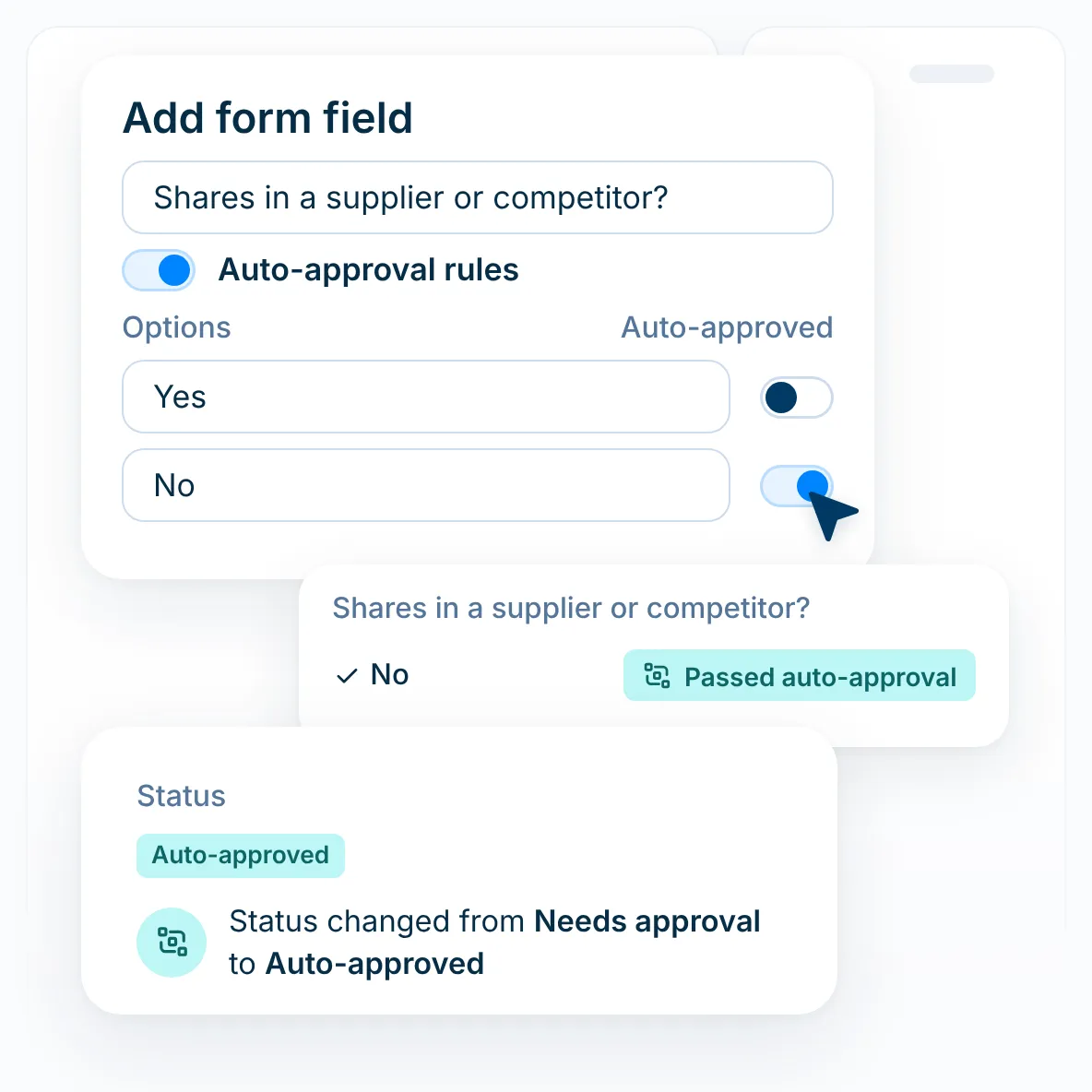
Most declarations need no action, so routine ones can be approved automatically, and your time goes to the ones that need judgment.
Set form rules that approve a declaration without review, for example when every answer is “no”
Assign a declaration to a colleague in legal, HR, or finance for review
Record the actions taken and the reasoning behind each decision
Move each one from review to a final decision, and reopen it if circumstances change
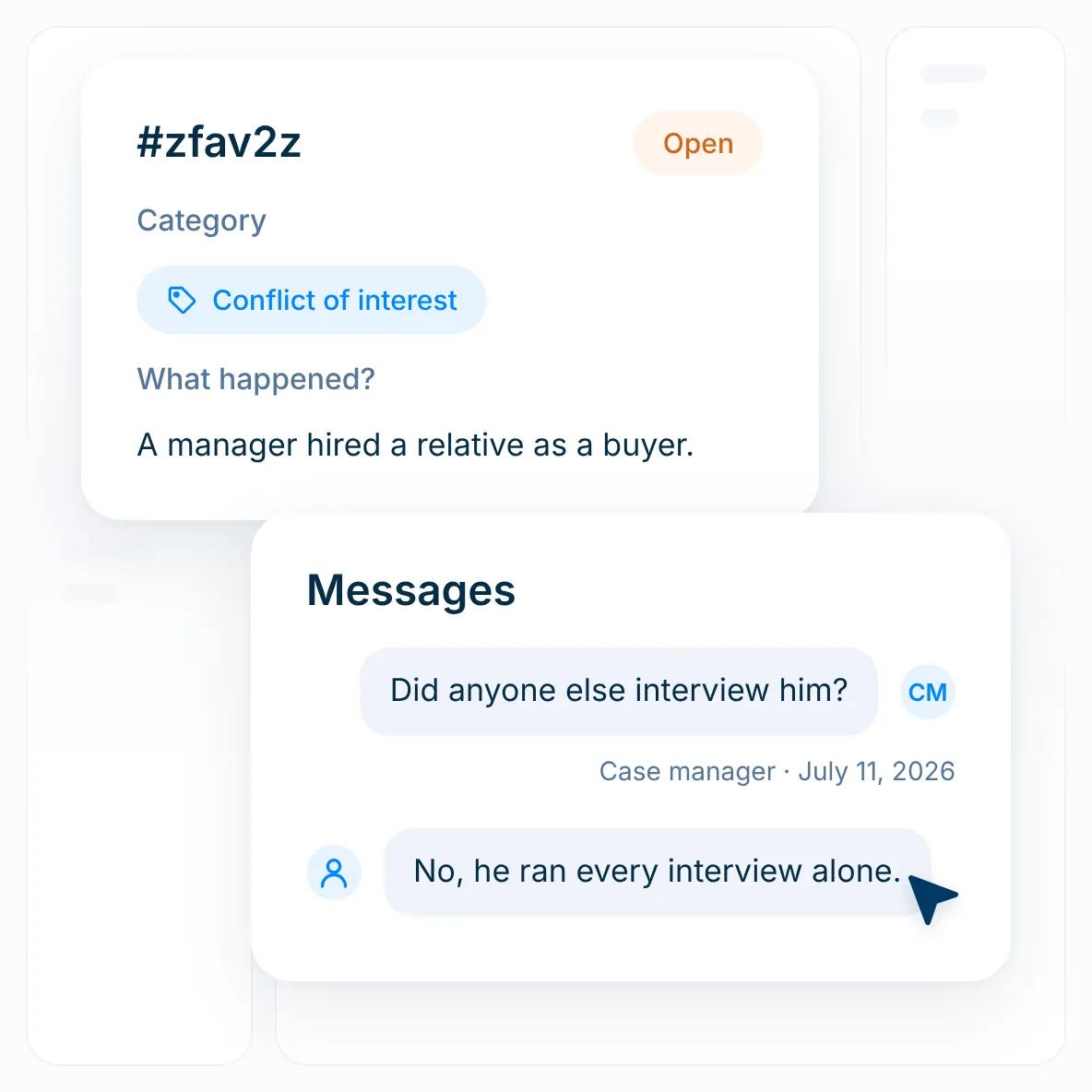
Sometimes a colleague spots a conflict first, like a manager hiring a relative or a buyer close to a supplier. Their report becomes a case, kept apart from your declarations but under the same login.
Add conflicts of interest as a reporting category, with the questions you need answered
Ask follow-up questions in a private chat, whether or not the reporter shares their name
Hide the case from anyone it names, and from their managers
Open an investigation when needed, with interviews, evidence, and findings kept together


Disclosure Management, Anonymous Reporting, and Case Management work together in FaceUp. Declarations surface the conflicts people know about, and reports and cases handle the ones someone else notices.
Employees declare conflicts, gifts, and outside activities on forms you send. You see who’s pending and review each one.
See how disclosures workA colleague who sees an undeclared conflict can report it online, in the app, or by hotline, anonymously if they choose.
See how reporting worksEach report gets an owner, deadlines, and a full history, and moves into an investigation when it needs one.
See the case workflowEvery declaration stays confidential, from the first answer to the final decision. FaceUp fits the systems and policies you already have, and your team adjusts it without IT.

See who was asked and who's answered, then remind everyone still pending in one click, as often as you need.

Auto-approve routine “nothing to declare” answers, so your team only reviews the ones that need judgment.

Declarations are stored in your region, outside your IT systems, and only colleagues with access can open them.

Run separate forms for new joiners, the annual refresh, and changes in someone's role or situation.

Sync employees from BambooHR or Paylocity, get alerts in Slack or Microsoft Teams, and connect more apps via Zapier.

Edit questions and guidance each round. Once answered, forms lock so everyone sees the same version.
Laws, regulations, and standards like these expect you to show how conflicts were declared, reviewed, and resolved. FaceUp keeps that record for every declaration, ready when an auditor or regulator asks.
Sarbanes-Oxley Act, Section 406 (code of ethics for senior financial officers)
NYSE Listed Company Manual, Section 303A.10
Nasdaq Listing Rule 5610
DOJ Evaluation of Corporate Compliance Programs
Companies Act 2006, sections 175 and 177
Bribery Act 2010, section 7 (failure to prevent bribery)
Markets in Financial Instruments Directive (MiFID II), Article 23
Federal Decree-Law No. 32 of 2021 on Commercial Companies
Companies Law (Royal Decree M/132 of 1443H)
ISO 37001:2025 (Anti-bribery Management Systems)
ISO 37301:2021 (Compliance Management Systems)


As we grew from hundreds to thousands, we needed a clean process that stayed organized and could be shared across multiple admins and remotely.

Jean Pierre “JP” Chavez
Director of People Experience Partners, BairesDev
FaceUp lets us assign cases fast, track trends across subsidiaries, and give leadership clear, actionable oversight.

Josh Carter
Chief Legal Officer & Secretary, ATSG
FaceUp enables World Relief to unify its multiple reporting processes within a single, streamlined system, enhancing efficiency and accountability.

World Relief Representative
World Relief
FaceUp is a must for companies with multiple locations. It makes gathering employee feedback efficient and anonymous, even across different countries.

Thomas Rodny
HR Director, Sportisimo
I recommend FaceUp for any company dealing with whistleblowing. It is safe and easy to use. Plus, it helps combat bullying in schools.

Rohia Hakim
Compliance expert, CTP Invest
I've admired FaceUp since its early days combating school bullying. Now, it helps companies protect their reputation, employees, and culture.

Thomas Kafka
Partner, Forensics & FinCrime, Deloitte
FaceUp has been a game-changer. It’s intuitive, packed with useful features, and backed by a responsive support team.

Vanessa Crawford
HR Director, ADvTECH Group
FaceUp made the setup process a breeze. The customer service was amazing, and the user experience is intuitive and easy to navigate.

Tracey Banta
HR Manager, Evention
An intuitive and user-friendly platform. Its simplicity allows for a quick implementation, and I appreciate how flexible it is to meet our needs.

Jaime Gómez Balderrama
Director, Ética Integral
To be compliant, we implemented FaceUp. It ticks the boxes for security, anonymity, and accessibility. Their team is always available to support us.

Jiri Linek
Ministry of Foreign Affairs of the Czech Republic
FaceUp protects sensitive compliance data with independently verified security controls, so employees can trust the channel and speak up safely.
Review our security


