

Bring All Confidential Reports Into One Secure Place
We’ll assess your needs and recommend the right setup for anonymous reporting or surveys - aligned with your compliance or HR goals.
Whistleblowing

Alaa El-Shaarawi
Copywriter and Content Manager
Published
2024-09-20
Reading time
10 min
Table of contents
Subscribe to our newsletter

Most workplace misconduct doesn’t come to light through audits or external investigations, but from inside the organization itself. According to the ACFE, 43% of occupational fraud cases are detected through whistleblowing, making it the most common way misconduct is uncovered.
What this reveals isn't just the scale of internal reporting, but its dependence on one critical factor: whether employees feel safe enough to speak up before issues escalate into legal, financial, or reputational damage.
As a result, whistleblowing has become a core part of modern compliance programs. Organizations are under growing pressure from regulators, investors, employees, and customers to identify concerns earlier and respond in a consistent, transparent way.
A whistleblowing system gives employees a structured way to report concerns such as fraud, harassment, corruption, discrimination, conflicts of interest, safety violations, data misuse, or retaliation. For leadership, it acts as an early visibility layer into risks that often remain hidden until they begin to cause measurable harm.
But having a system in place isn’t the same as having one that works in practice. The effectiveness of whistleblowing depends less on its existence and more on trust. A reporting channel alone doesn’t create a reporting culture. Employees need confidence that concerns will be handled confidentially, investigated fairly, and followed by clear, consistent action.
That’s what ultimately determines whether whistleblowing becomes a functional part of risk management, or just a policy that exists on paper.
In most organizations, whistleblowing is one of the earliest systems for detecting internal risk. The way employees report concerns often determines how quickly issues are identified, contained, and resolved.
Strong whistleblowing programs do more than meet regulatory expectations. They help organizations surface problems earlier, improve decision-making, and reduce the likelihood of small issues escalating into operational or reputational damage.
The benefits become especially visible in how organizations detect misconduct, build trust, and maintain control over risk as they scale.
Employees are usually the first to notice unethical behavior. When issues are reported early, organizations can address them before they escalate into lawsuits, regulatory investigations, financial losses, or public scandals. This is why encouraging employees to report wrongdoing early is such a critical part of effective risk management.
This becomes even more important in industries with high compliance exposure, including finance, healthcare, manufacturing, education, and technology. While each sector operates under different regulatory pressure, the underlying risk is the same: small issues become serious failures when reporting channels are weak, fragmented, or ignored.
According to the ACFE, organizations lose an estimated 5% of annual revenue to fraud on average, highlighting how quickly undetected misconduct can turn into significant financial impact.
Employees are more likely to trust leadership when concerns are taken seriously and followed through with visible action. A transparent reporting process signals that standards apply consistently across the organization, including at senior levels.
Over time, this builds a culture where people feel safer raising concerns and where accountability becomes part of day-to-day operations, not just policy. This often results in earlier reporting of issues that would otherwise remain unspoken until they escalate.
Many regulations now require secure reporting mechanisms and documented investigation procedures. Companies that implement structured whistleblowing processes are in a stronger position during audits, investigations, and compliance reviews.
This includes frameworks such as the EU Whistleblower Protection Directive, SOX, and Dodd-Frank, along with industry-specific regulations.
These are enforced by regulators such as the Securities and Exchange Commission (SEC), the Department of Justice (DOJ), and the IRS, particularly in cases involving securities violations, fraud investigations, and tax-related misconduct.
Internal reporting gives companies the opportunity to resolve issues before they become public. When concerns are handled early and appropriately, organizations are more likely to maintain trust with employees, customers, and external stakeholders.
Without effective reporting mechanisms, unresolved issues are more likely to surface externally through complaints, legal action, or public disclosure, often amplifying reputational impact.
Modern reporting systems help compliance teams manage cases more effectively by bringing reports, evidence, and communication into one place. This improves consistency in how investigations are handled and reduces the risk of important details being missed.
It also helps ensure that investigations follow a documented process, making outcomes easier to justify during audits or regulatory reviews.
Ultimately, the value of whistleblowing is defined not only by how issues are reported, but by how consistently they are managed through to resolution.
FaceUp supports this end-to-end process through a unified whistleblowing and case management solution that centralizes reporting, enables secure workflows, and maintains consistent documentation across cases.
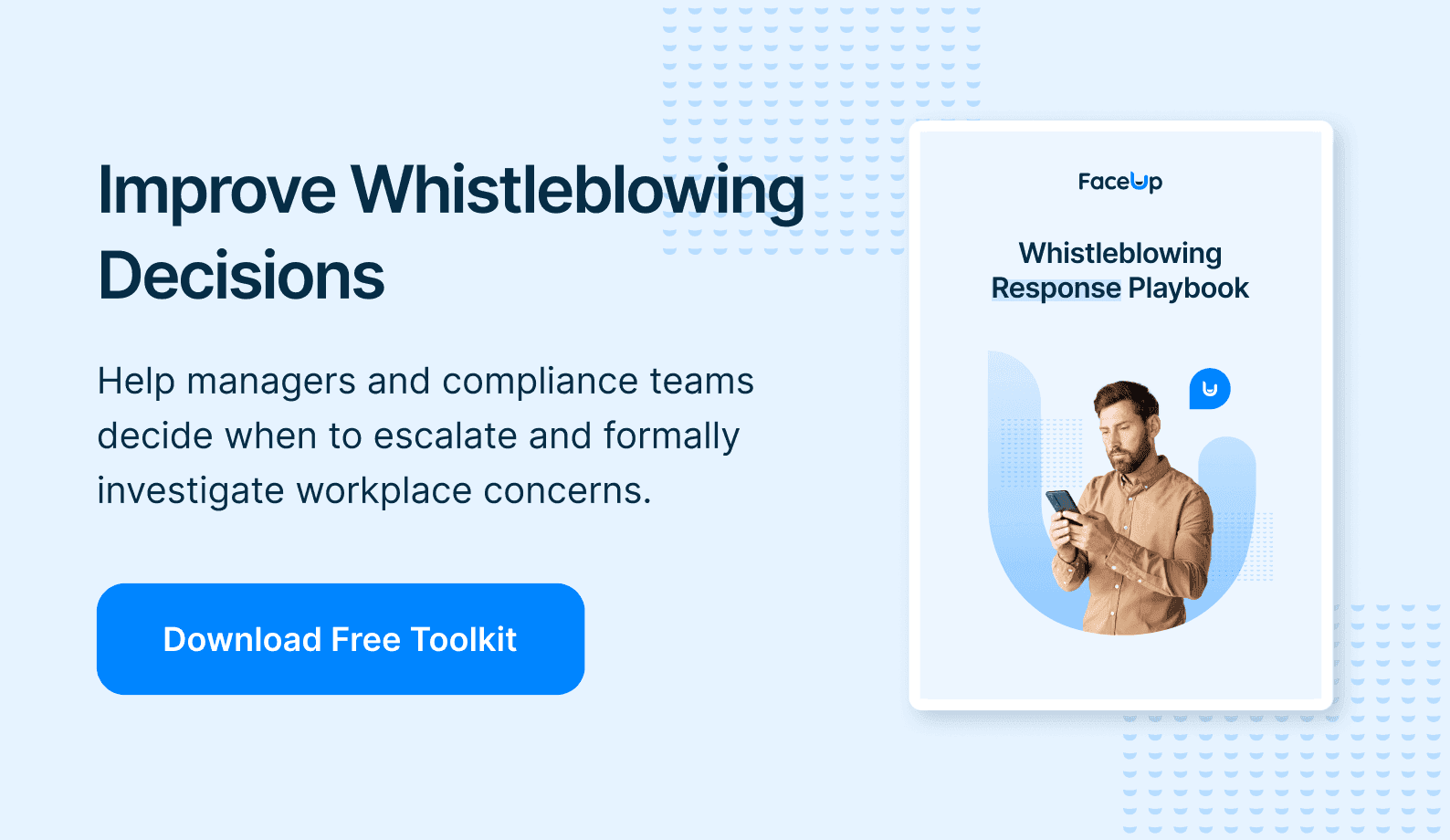
Our Whistleblowing Response Playbook helps managers and compliance teams respond to workplace concerns earlier, handle escalation more consistently, and strengthen reporting integrity across the organization.
Scenario | Immediate Actions | When to Escalate | Response Guide |
|---|---|---|---|
Employee excluded after submitting a report |
|
| COMMON FAILURES: Assuming retaliation only means termination or demotion. LEADERSHIP DISCUSSION: Would reporting discourage future whistleblowing in your organization? |
The complete playbook includes 7+ whistleblowing scenarios, escalation workflows, and investigation guidance designed to help managers and compliance teams respond earlier and more consistently.
Even strong programs face obstacles. Many organizations struggle with low reporting rates, inconsistent investigations, or employee distrust. These challenges typically appear across three operational areas: reporting behavior, investigation quality, and system fragmentation.
FaceUp helps address these challenges by combining anonymous reporting, structured case management, and secure communication in one platform, improving investigation consistency and process reliability.
Retaliation remains one of the biggest barriers to reporting, with around a third of US employees saying fear of negative consequences would prevent them from speaking up.
Employees may worry about losing opportunities, damaging relationships, receiving negative performance reviews, or being excluded by management or peers. Even perceived retaliation can suppress future reporting across the organization, reducing the likelihood that issues are raised at all.
Employees are unlikely to report concerns if previous cases disappeared without updates or visible action. Trust breaks down when reporting feels performative rather than action-driven.
Over time, this creates a perception that raising concerns has little impact, which leads to fewer reports and more issues remaining unresolved until they escalate.
A reporting system is only as effective as the process behind it. Delayed responses, inconsistent investigations, poor documentation, or confidentiality breaches can create additional legal and cultural risks.
When case handling lacks structure, similar issues may be treated differently depending on who is managing them, which further reduces confidence in the system.
Some organizations worry that anonymous reporting limits evidence collection or increases false claims. In reality, most anonymous reports contain enough detail to begin an investigation when organizations use structured intake forms and secure follow-up communication.
The main challenge isn't anonymity itself, but making sure there's a reliable way to clarify details without exposing the reporter.
Managing reports manually across spreadsheets, emails, and disconnected systems creates operational strain. As reporting volumes increase, compliance teams need workflows that support prioritization, escalation, documentation, and reporting.
Without this structure, teams often spend more time managing administration than actually resolving cases, which slows down response times and reduces overall effectiveness.
Employees usually prefer to report concerns internally first when they believe the company will respond fairly.
That matters because unresolved internal concerns often become external problems. Reports may eventually reach regulators, labor authorities, courts, journalists, social media, or even the federal government when employees feel ignored or unsafe.
Organizations that invest in trusted reporting systems create an opportunity to resolve issues earlier and more constructively. This requires more than anonymity. Employees also expect:
When these elements are missing, reporting rates decline and organizational risk shifts outside the organization entirely.
The most effective programs treat whistleblowing as part of broader compliance and risk management, not as a standalone HR policy. High-performing organizations typically focus on five areas:
Whistleblower protections continue to expand globally, increasing expectations for employers. While the details vary by country, most legal frameworks follow a similar principle: they’re designed to protect individuals who report misconduct and to ensure organizations respond appropriately to concerns raised in the public interest.
In the European Union, the EU Whistleblower Protection Directive introduced requirements around secure reporting channels, confidentiality, and retaliation protection for many organizations.
It sets a baseline for whistleblower protection laws across member states and strengthens safeguards for potential whistleblowers, particularly around anti-retaliation measures and reporting confidentiality.
In the United States, several key laws form the backbone of whistleblower protection and enforcement:
Together, these frameworks cover both protection from retaliation and mechanisms for reporting misconduct involving US securities, tax fraud, and fraud against taxpayers.
Many countries now require organizations to:
These obligations are designed to protect whistleblowers and encourage reporting in the public interest, especially in cases involving tax fraud, securities violations, or fraud against taxpayers.
Many systems also provide financial rewards for valid disclosures, particularly under SEC and IRS enforcement frameworks, including structured whistleblower reward programs.
Compliance teams should regularly review local legal obligations, especially for multinational organizations operating across multiple jurisdictions. You can find a full overview of applicable frameworks and regional requirements on FaceUp’s Laws & Regulations page.
As reporting requirements become more complex, many organizations are moving away from manual systems. Modern compliance platforms help companies:
Together, these capabilities reduce the operational friction that typically slows down investigations and creates inconsistencies in how cases are handled.
For compliance leaders, this improves visibility while reducing operational bottlenecks. For employees, it creates a more accessible and trustworthy way to report concerns, increasing the likelihood that issues are raised early.
Effective whistleblowing isn’t defined by the number of reports, but by how consistently risks are identified, investigated, and resolved.
When reporting systems are fragmented or unclear, issues often remain unresolved until they escalate into regulatory, financial, or reputational exposure. In many cases, the challenge isn’t awareness of problems, but the lack of a structured way to manage them once they’re reported.
A reliable reporting framework depends on three elements: accessibility, confidentiality, and consistent case handling.
FaceUp supports this structure by combining anonymous reporting, case management, and investigation workflows in one platform. This gives compliance teams a single system to manage risks from intake to resolution, with full documentation and audit-ready traceability built in.
Organizations that want to structure whistleblowing as a core compliance capability can explore how it fits into a broader reporting and risk management framework in FaceUp’s Whistleblowing overview.
Whistleblowing shouldn’t sit at the edge of compliance operations. It belongs at the center of how organizations identify and manage risk early.
The companies that treat reporting as a structured compliance function, not an informal channel, are the ones that surface issues earlier and reduce long-term exposure.
FaceUp helps organizations move from fragmented reporting channels to a controlled compliance process that is easier to manage, audit, and scale.
Book a demo to see how FaceUp helps compliance teams centralize reporting, standardize investigations, and reduce risk exposure across the organization.
*This post was updated on 25/05/2026.
We’ll assess your needs and recommend the right setup for anonymous reporting or surveys - aligned with your compliance or HR goals.
Keep Reading
Alaa El-Shaarawi2026-09-095 min
Legal & Compliance
Mary Shirley2026-07-285 min
Workplace Environment
Marie Roland2026-07-276 min
Legal & Compliance
Marie Roland2026-07-275 min
Legal & Compliance