How Global Companies Stay Compliant as They Scale Across Borders
Legal & Compliance

Alaa El-Shaarawi
Copywriter and Content Manager
Published
2026-07-21
Reading time
11 min
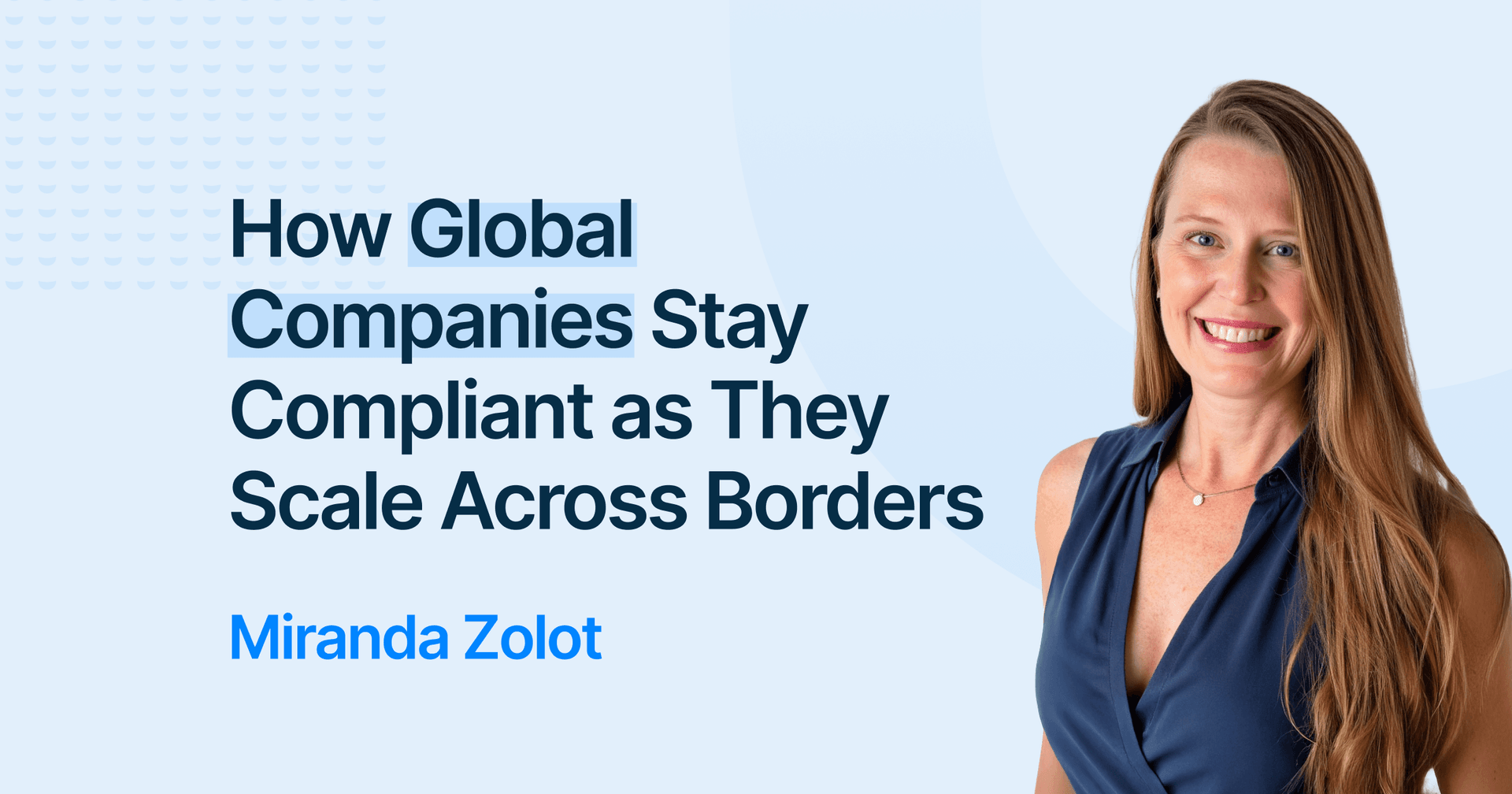

Table of contents
Subscribe to our newsletter

How Global Companies Stay Compliant as They Scale Across Borders
Expanding into new markets has never been easier. What once required months of planning, legal setup, and relocation now happens in a matter of weeks. A role opens, a hire is made, and suddenly your workforce spans multiple countries, time zones, and legal systems.
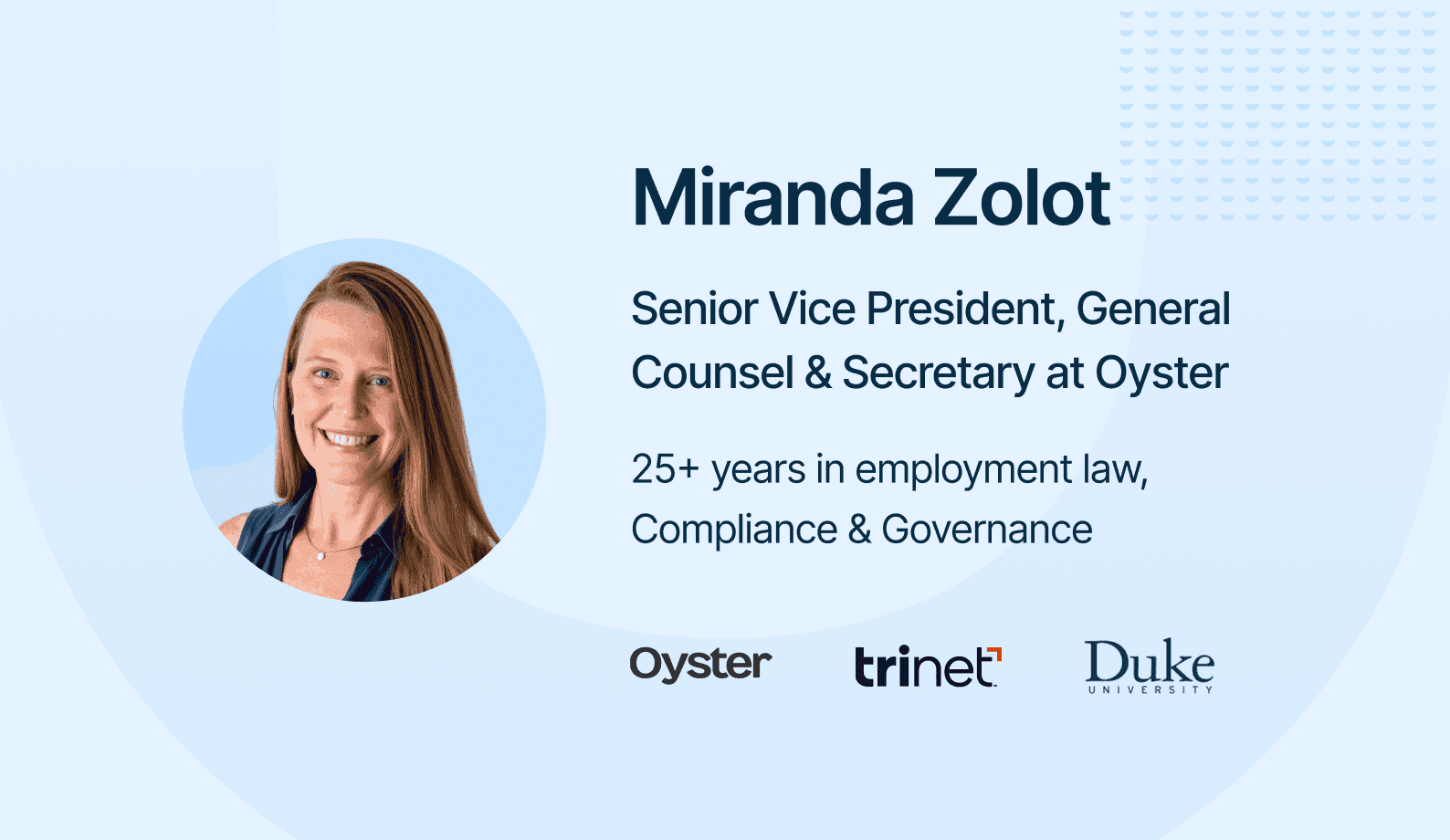
But as Miranda Zolot, General Counsel at Oyster, explains, that shift comes with a fundamental change in how companies operate.
“The moment you start hiring internationally, you’re no longer operating in one system. You’re navigating many at once.”
That's where things start to break.
In a FaceUp webinar, Daniëlla Gyselinck spoke with Miranda about what really happens when companies scale across 80+ countries. What gets overlooked, where friction builds, and why visibility becomes one of the hardest things to maintain as organizations grow.
Global Hiring Changed How Companies Operate
For most of modern business history, employment followed a relatively stable model. Work was tied to a location, and people moved to be part of it. That structure created consistency in how companies operated. Legal frameworks were local, cultural expectations were shared, and teams worked within a single, familiar environment.
Remote work disrupted that model almost overnight.
As Miranda points out, companies are no longer limited to hiring within commuting distance or even within the same country. They can access talent globally, which creates entirely new opportunities. People can live where they want, and companies can build teams based on capability rather than geography.
At the same time, this shift removed many of the implicit guardrails companies relied on. Instead of operating within one legal and cultural system, they now have to navigate several simultaneously. Each country brings its own regulations, expectations, and ways of working.
What looks like a simple hiring decision quickly becomes part of a much more complex operating model.
Where Global Expansion Starts To Break
One of the most common patterns Miranda sees is companies applying what works in one market to another without adjusting for local differences. These decisions aren’t usually intentional. In most cases, they come from a place of efficiency. If something works well in one environment, it feels natural to extend it.
However, this is often where friction begins to build.
The first signals are usually cultural. Communication styles, expectations around feedback, and workplace norms vary significantly across regions. What’s considered direct and efficient in one country may be perceived as abrupt or confrontational in another. Over time, these differences can create misunderstandings that affect performance and collaboration.
The legal layer adds another level of complexity.
Miranda highlights the contrast between the US and EU as a clear example. In the US, employment frameworks are designed to provide flexibility to employers. In many European countries, the system is structured to protect employees, particularly when it comes to maintaining ongoing employment.
This difference has practical implications. Performance management, terminations, and even day-to-day expectations follow different rules. In some countries, poor performance alone isn't sufficient grounds for termination. Employers are expected to invest time and formal processes into supporting improvement.
Without understanding these differences early, companies often find themselves in situations that are more complex and costly than anticipated.
The Hidden Costs Of Global Growth
When companies think about expanding internationally, they usually account for visible costs such as legal support or operational setup. What’s less obvious is how quickly indirect costs begin to accumulate when the underlying systems aren’t designed for global complexity.
Miranda points out that exit processes alone can be significantly more expensive than expected. In some regions, terminating an employee can involve months of salary, formal procedures, and strict documentation requirements. Missing local obligations, such as additional salary payments or notification processes, can result in fines or prolonged disputes.
Beyond the financial impact, there’s a broader operational cost.
“These things can be very distracting,” she explains. When issues arise, teams are pulled away from their core work to resolve them. Legal and HR functions shift into reactive mode, focusing on fixing problems instead of building systems that prevent them.
There are also risks that are harder to quantify but equally important. Data privacy expectations differ significantly across regions, and mishandling employee data can lead to both regulatory and reputational consequences. Similarly, failing to capture or respond to employee concerns can create underlying issues that remain invisible until they escalate.
A practical insight Miranda shares is that many of these challenges are predictable. With average employee tenure now around 18 to 24 months, turnover isn’t an exception but an expectation. Companies that plan for this, particularly in regions with higher exit costs, are better positioned to manage it effectively.
Why Global Hiring Is Still Worth It
Given these challenges, it’s reasonable to question whether global expansion is worth the effort. For Miranda, the answer is clear.
“The humans are worth it every single time.”
Access to global talent allows companies to find people who align more closely with their needs and culture. It also enables organizations to build more diverse teams, which consistently perform better due to the variety of perspectives they bring.
“If you want to be better, you need different perspectives.”
There are also operational advantages. Companies can manage costs more effectively by hiring in different regions, and they can access talent that may not be able to relocate due to immigration constraints.
At the same time, global hiring has broader implications. Remote work reduces the need for relocation, which can improve employee experience and retention. It allows individuals to remain in their communities, supporting local economies and creating more sustainable work models.
The benefits are clear, but they depend on a company’s ability to manage the complexity that comes with operating globally.
Why Global Compliance Gets Harder As You Scale
As organizations expand, compliance does not simply become more complex. It becomes less predictable. Miranda describes this as a natural lag between how work evolves and how laws are updated.
“The law doesn’t change overnight, but the way we work does.”
This creates gaps between what companies are doing in practice and what regulations explicitly cover. In regions like the European Union, even when directives are introduced, they’re implemented differently across member states. The result isn’t a single framework, but a collection of local interpretations.
“It’s always going to be a patchwork,” she says.
For companies, this means operating in an environment where there is often no single, clear answer. Decisions need to be made based on available guidance, local expertise, and a degree of interpretation.
Waiting for complete certainty isn't realistic. As Miranda puts it, “if you wait, the bus will have already left the station.”
Instead, companies need to build the capability to adapt as regulations evolve.
Why Visibility Matters In Global Teams
While legal and operational complexity are significant, one challenge becomes increasingly important as companies scale globally: maintaining visibility into what’s happening within the organization.
In a local environment, many issues surface naturally. Informal conversations, in-person interactions, and shared context make it easier to identify concerns early.
In a distributed workforce, those signals are less visible.
Cultural differences can influence whether employees feel comfortable raising concerns. Time zone differences reduce opportunities for real-time communication. Without clear systems in place, feedback does not always reach the people who need to act on it.
This is where internal reporting systems play a critical role.
In the EU, whistleblowing systems are a legal requirement for many organizations. However, their importance goes beyond compliance. They provide a structured and accessible way for employees to raise concerns, share feedback, and highlight issues that might otherwise remain hidden.
Without that visibility, companies are left with gaps in their understanding of what’s happening across their teams.
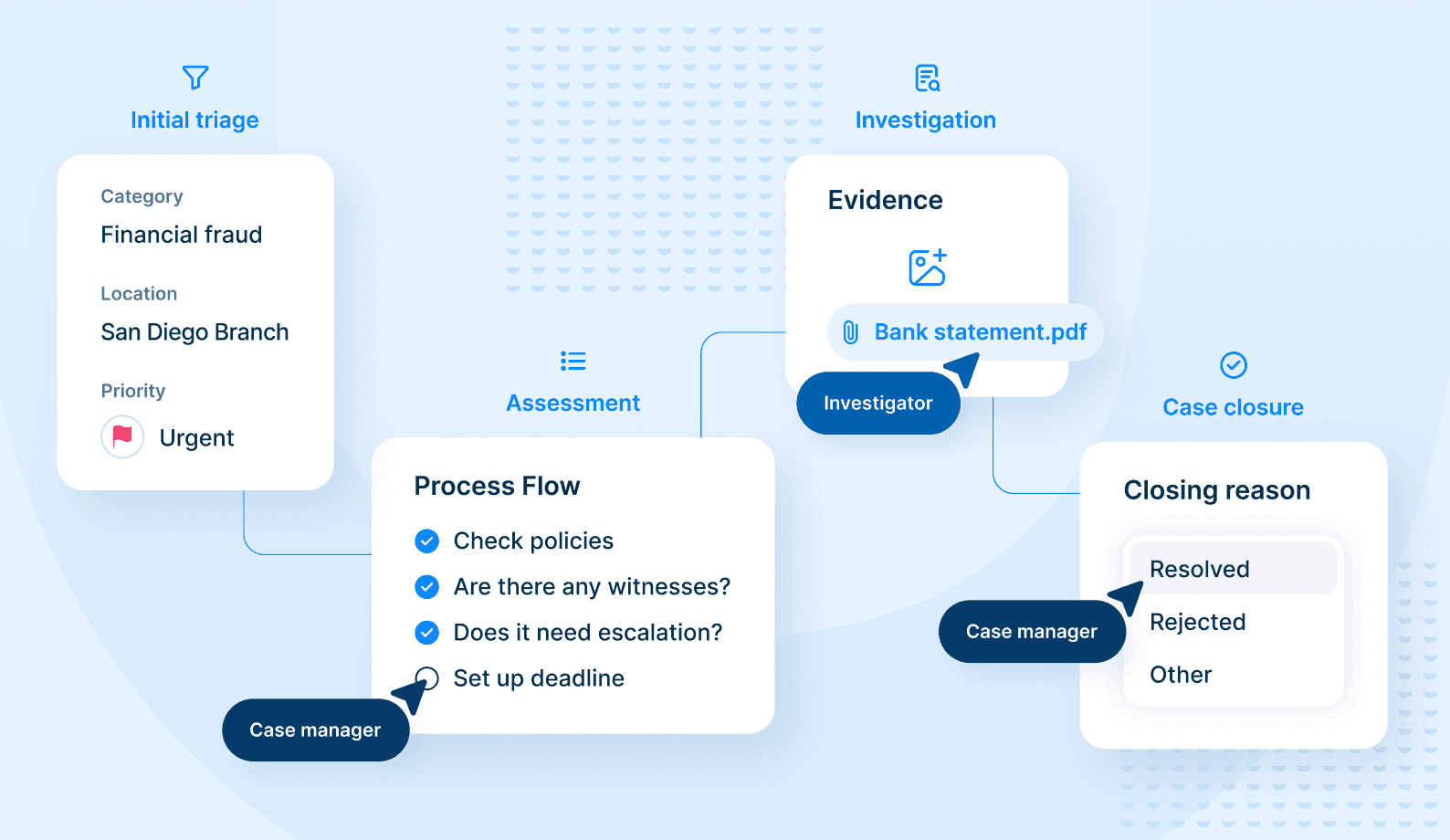
This is where whistleblowing platforms like FaceUp come in, giving companies one place to capture concerns across countries, route cases to the right people, and manage investigations end to end, while staying aligned with local whistleblowing and data privacy requirements.
A Lack Of Reports Is Often A Sign Of A Deeper Problem
One of the more surprising insights from the conversation comes when Miranda addresses a common assumption: that not receiving any reports is a positive sign.
Her response is immediate.
“I think that’s terrible.”
A lack of reports doesn’t necessarily mean that everything is working well. In many cases, it indicates that employees are not engaging with the system. They may not be aware of it, trust it, or believe that reporting will lead to meaningful action.
For Miranda, that creates dangerous blind spots.
"If I’m not getting a report, then I have no way of knowing if my messaging is getting across, if there’s a problem that’s brewing, or if we're being effective as counselors and HR professionals in supporting our workforce."
Without that feedback, companies lose the ability to identify issues early, improve processes, and support their workforce effectively. In a global organization, where informal signals are already limited, this lack of visibility becomes even more critical.
Having a reporting system in place is only part of the solution. It also needs to be visible, accessible, and trusted by the people it is designed to support.
What Makes An Effective Global Reporting System
From Miranda’s perspective as General Counsel, an effective reporting system must meet both legal and practical requirements.
It needs to be compliant across jurisdictions, including language accessibility and data privacy standards. This is particularly important in regions with strict regulations, where non-compliance can have significant consequences.
At the same time, it must be easy to implement and manage. Legal and compliance teams often operate with limited resources, and complex systems create unnecessary friction.
Equally important is usability. If employees find the system difficult to access or navigate, they are less likely to use it.
Finally, the system must support the full lifecycle of a report. This includes intake, investigation, documentation, and resolution, all while maintaining confidentiality and ensuring that information is handled appropriately.
However, functionality alone isn’t enough.
“You have to show people what happens when they report. Transparency in how reports are handled is what builds trust and encourages continued use."
Building A Reporting System Employees Trust
At Oyster, creating an effective reporting system required more than selecting the right tool. It involved aligning processes, communication, and culture around it.
Previous reporting channels were fragmented, making it difficult for employees to know where to go. Oyster replaced them with a single, consistent reporting system, integrated it into company policies, reinforced it through training, and regularly reminded employees how and when to use it.
That investment paid off. Miranda recalls an employee raising concerns through the reporting system about how gender pronouns were used during a company presentation. Rather than being overlooked, the feedback prompted a broader conversation and ultimately improved the company's approach.
Rather than simply resolving the issue behind the scenes, Oyster acknowledged the report and thanked the employee for speaking up.
“Thank you for using this resource, for sharing your concern, and for making us better as a company.”
Reflecting on the experience, Miranda says:
“It was really a great example of the system working exactly how you wanted it to.”
Without a trusted reporting channel, that feedback might never have surfaced. By making reporting visible, responding transparently, and showing employees that concerns lead to action, Oyster turned a single report into an opportunity to strengthen trust across the organization.
Scaling Globally Requires Stronger Systems
For companies preparing to expand internationally, Miranda’s advice is grounded in practicality.
The process begins with clarity. Understanding what roles need to be filled and why helps guide decisions about where and how to hire.
From there, companies need to evaluate the right employment structures for each region. Contractors, employer-of-record solutions, and local entities each serve different purposes depending on the situation.
Operational considerations follow. Communication, data handling, and compliance processes need to align with how teams will actually work across locations.
Finally, companies should not attempt to manage this complexity alone. Using experienced partners can help reduce risk and provide the expertise needed to navigate unfamiliar environments.
“Test, iterate, and move forward,” Miranda advises.
Global expansion isn’t about getting everything right from the start. It’s about building systems that allow the organization to adapt as it grows.
If You're Scaling Globally, Start Here
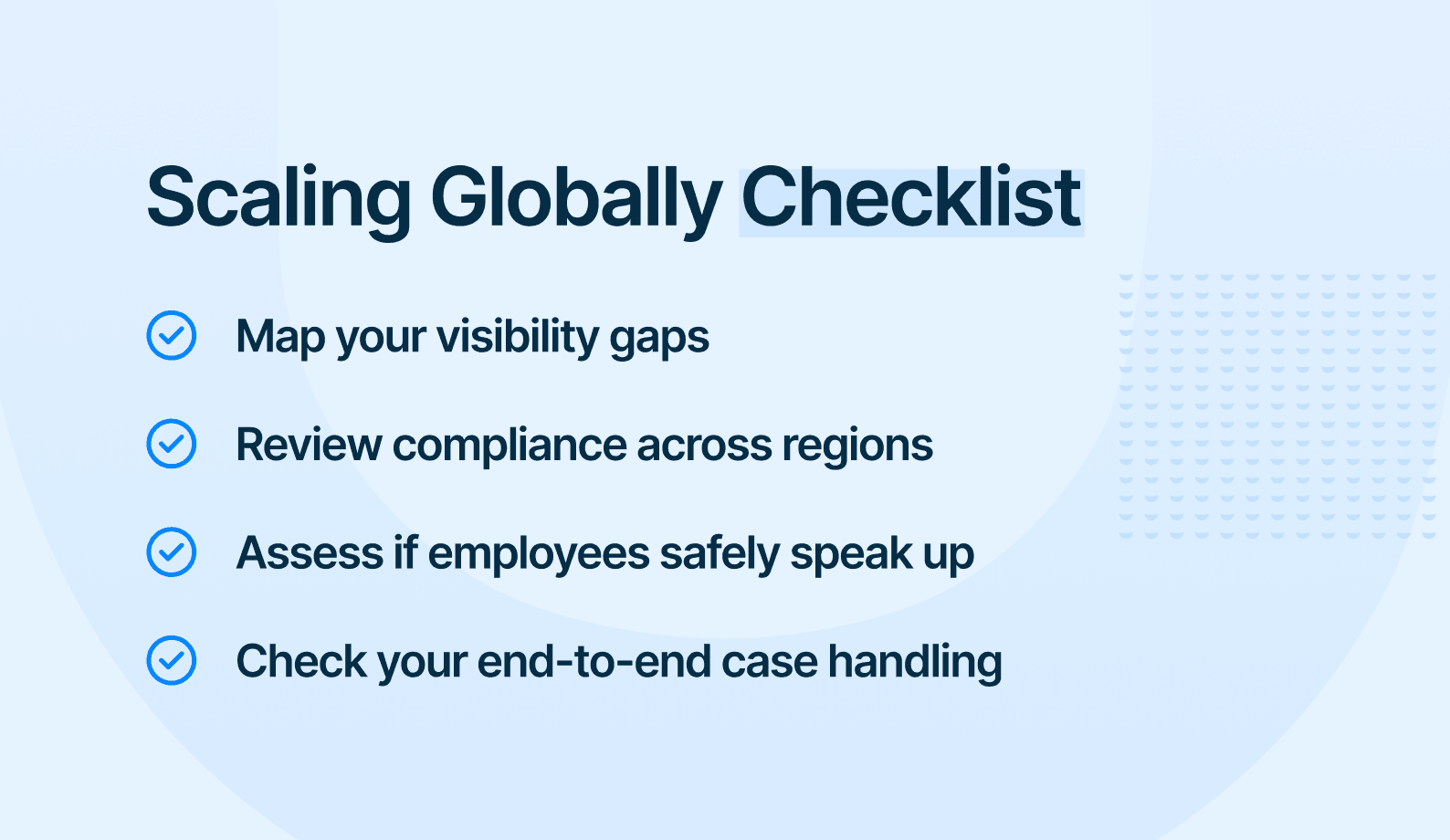
Map how visibility works today
Identify where signals about risk, feedback, and employee concerns currently surface across your organization. Then ask: do these insights reach the right people in a consistent way, or are they fragmented across tools, regions, or teams?Review how compliance processes hold up across regions
Look at key workflows like hiring, performance management, and exits. Are they clearly documented and adaptable to local requirements, or do they rely on assumptions from one market? Gaps here often only become visible when something goes wrong.Assess whether employees can safely and easily speak up
Consider whether your reporting channels are visible, accessible, and trusted across different cultures and locations. A lack of reports may not mean a lack of issues. It often signals a lack of trust or awareness.Check if your systems support end-to-end case handling
If an issue is raised, can it be tracked, investigated, and resolved within one structured process? Or does it require manual coordination across multiple tools? Consistency here is critical as complexity grows.
Growth Works When You Can See More
Scaling globally is more than just a legal or operational challenge. It’s a visibility challenge.
As organizations become more distributed, it becomes easier for risks, concerns, and misalignments to go unnoticed. The systems that worked in a single location are no longer enough.
The companies that succeed are those that recognize this early. They invest in the structures, processes, and tools that allow them to maintain visibility across their workforce.
Because in global organizations, what you can’t see is often where the biggest risks begin.
Keep Reading
Alaa El-Shaarawi2026-10-0510 min
Gulf construction safety: Why on-site hazard reporting keeps breaking
Legal & Compliance
Alaa El-Shaarawi2026-10-028 min
UAE whistleblowing: The biggest programs are being built where no law requires them
Legal & Compliance
Alaa El-Shaarawi2026-09-249 min
EU AI Act Whistleblowing: What Changed on August 2, 2026
Legal & Compliance
Alaa El-Shaarawi2026-09-095 min
Introducing Documents: Your Own Compliance Library in FaceUp
Legal & Compliance