

Bring All Confidential Reports Into One Secure Place
We’ll assess your needs and recommend the right setup for anonymous reporting or surveys - aligned with your compliance or HR goals.
Legal & Compliance

Marie Roland
Partnership Marketing Manager
Published
2026-02-26
Reading time
6 min
Table of contents
Subscribe to our newsletter

When compliance failures escalate into criminal investigations, the consequences extend far beyond legal fees. Leadership credibility suffers. Employee trust erodes. Reputational damage lingers long after court proceedings end.
A recent high-profile corporate espionage dispute in the HR technology sector illustrates how quickly internal misconduct can evolve into serious legal exposure.
What reportedly began as a civil lawsuit involving alleged theft of sales leads, customer data, and product roadmaps later expanded to include racketeering claims. By early 2026, major outlets reported that federal authorities had opened a criminal investigation. Both sides deny wrongdoing.
Regardless of how the case resolves, it highlights a critical reality for HR and compliance leaders: Most large-scale compliance crises begin as smaller, detectable issues.
The difference between an internal investigation and a public scandal often comes down to infrastructure.

Long before headlines and legal filings, this situation would have existed as an internal operational reality. The dispute involves the handling of commercially sensitive information. Activity at that level doesn’t happen invisibly. It leaves traces inside systems and workflows.
Access to sensitive systems must occur. Information is viewed, downloaded, or shared. Colleagues have at least a general sense of who should be handling certain types of data and who shouldn’t. Inside the organization, those actions might not have immediately felt like “corporate espionage.”
They may have looked like:
Individually, none of these moments necessarily signal criminal conduct. In isolation, they’re easy to rationalize.
The real issue isn’t whether anyone could have predicted the scale of what followed. It’s whether early concerns, if noticed, would have been formally captured and assessed.
By the time litigation enters the picture, the question shifts from “Did misconduct occur?” to “What did the company know, and how did it respond?” That’s a much harder question to answer without a clear, documented record of how concerns were handled.
Corporate espionage, fraud, data misuse, or ethical misconduct rarely appear out of nowhere. There are usually indicators, such as:
When employees are unsure whether their identity will be protected, they hesitate. Concerns remain informal. Documentation is incomplete. By the time legal teams become involved, the issue has already escalated.
This is where infrastructure makes the difference. FaceUp was built to reduce that delay.
Having a reporting channel isn’t enough. What matters is what happens after someone uses it. Here’s how FaceUp supports HR and compliance teams in practice:
An effective whistleblowing system must be trusted.
FaceUp provides secure reporting channels with features such as:
Imagine a colleague notices repeated downloads of competitor intelligence files by someone outside the strategy team. They’re uncomfortable raising it directly. Through FaceUp, they can report the concern confidentially.
Compliance receives a structured alert with enough context to assess the risk discreetly.
The value here is timing. Instead of discovering potential misconduct months later during litigation, the organization can assess the concern when it first surfaces.
Receiving a report is only the beginning. How it’s handled determines the organization’s legal exposure and credibility.
In many public compliance failures, organizations struggle to demonstrate consistency. Conversations happen over email. Notes are scattered. Timelines are reconstructed after the fact.
FaceUp centralizes the process:
If a case later faces regulatory review or court scrutiny, the documentation already exists in one place. No scrambling to reconstruct events.
That level of structure protects both the organization and the individuals responsible for managing the case.
Fear of retaliation remains one of the biggest barriers to reporting. It’s not always dramatic retaliation. Often it’s subtle, such as slower career progression, social exclusion, or damaged relationships.
When employees believe speaking up will cost them professionally, silence becomes safer.
Because anonymity is embedded into FaceUp’s system design, reporters can follow up, share additional detail, and monitor case progress without exposing their identity. This continuity matters.
When employees trust the system, reporting increases. That visibility shows leadership that concerns are reaching the right channels before they escalate.
Modern organizations rarely operate in one jurisdiction. Compliance obligations span regions, and a single case may touch multiple regulatory frameworks.
Instead of managing this complexity through disconnected local tools, organizations use FaceUp as a centralized reporting and case management layer that can be configured to their specific legal and operational needs.
Workflows can be customized by region, department, or case type. Access rights can be tailored to ensure appropriate oversight while maintaining confidentiality. Global dashboards provide leadership with a consolidated view of open cases, response times, and resolution status.
If a European subsidiary raises a concern involving U.S.-based stakeholders, the case can be routed to the appropriate compliance or legal team without losing documentation continuity.
Consistency across borders reduces fragmentation and strengthens governance.
Strong compliance programs don’t rely solely on reacting to individual reports. They look for patterns.
FaceUp’s analytics allow compliance leaders to monitor trends such as:
Three isolated reports about “unusual competitor conversations” might seem minor on their own. Viewed together, they suggest a vulnerability. Pattern-level visibility shifts compliance from case-by-case reaction to informed oversight.
Whistleblowing and case management shouldn’t operate separately from workforce data.
FaceUp integrates with leading HR platforms, including:
When a report is submitted, investigators can immediately view relevant context such as role, department, manager, and location. This reduces manual data checks and shortens investigation timelines.
Integration also supports pattern detection. If multiple complaints involve the same manager or team, that visibility exists before promotion or restructuring decisions are made.
For organizations already using these platforms to manage distributed teams, adding FaceUp strengthens compliance oversight without disrupting daily workflows.
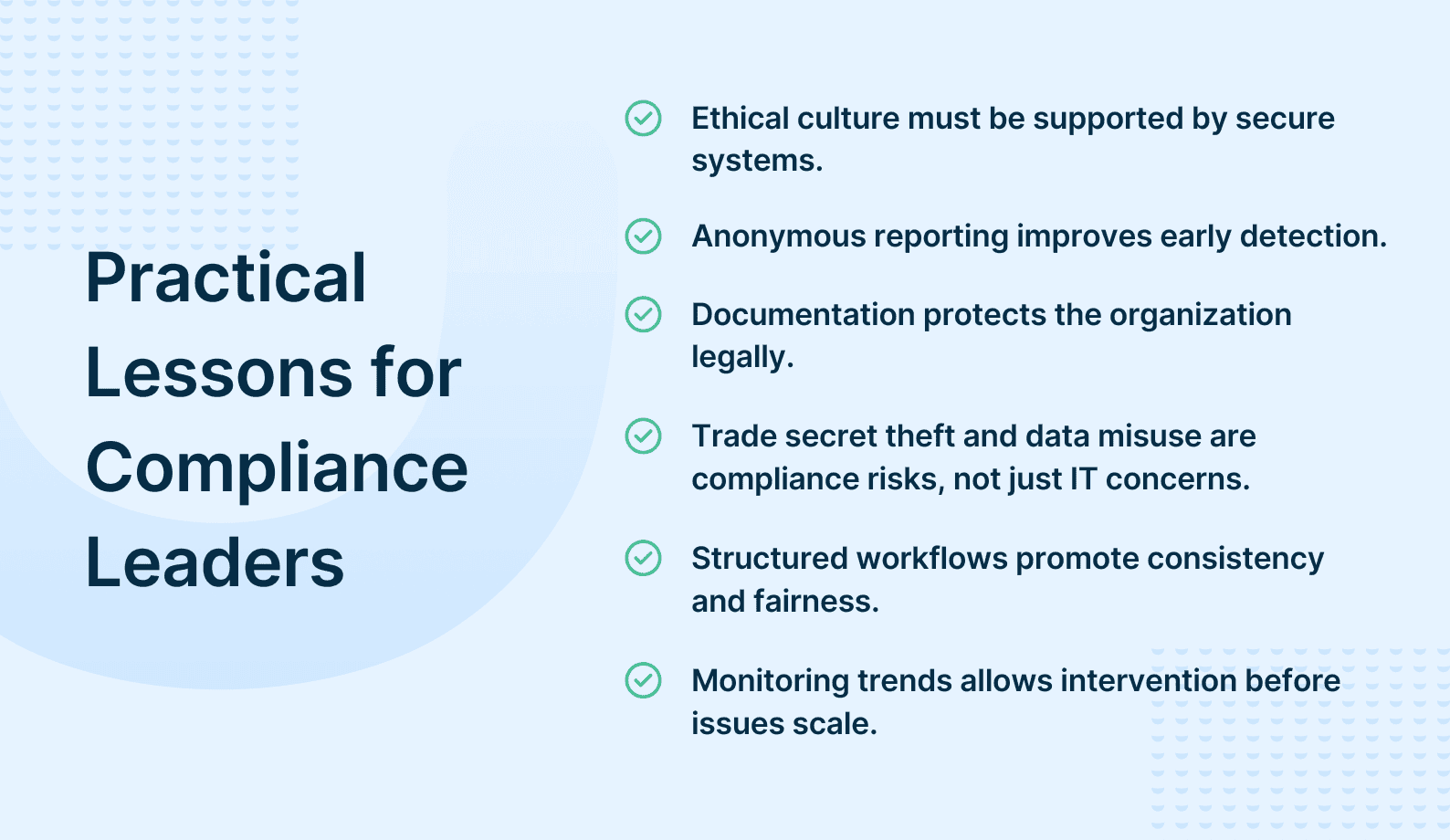
High-profile compliance disputes consistently reinforce several lessons:
These principles apply regardless of company size or industry.
When compliance systems fail, the consequences can include criminal investigations, racketeering allegations, regulatory penalties, and long-term reputational harm.
Escalation is rarely automatic. In many cases, earlier reporting, structured investigation management, and clearer oversight would have changed the trajectory.
FaceUp combines secure anonymous reporting, structured case management, global oversight, HR integration, and trend analytics to help organizations detect and resolve misconduct before it becomes a legal crisis.
If your organization already uses Rippling, Deel, or BambooHR, integration is straightforward. You can’t eliminate compliance risk entirely, but you can build the infrastructure that allows you to detect and manage it early.
The organizations that avoid major compliance scandals aren’t the ones without risk. They’re the ones that detect and manage it early.
We’ll assess your needs and recommend the right setup for anonymous reporting or surveys - aligned with your compliance or HR goals.
Keep Reading
Alaa El-Shaarawi2026-10-0510 min
Legal & Compliance
Alaa El-Shaarawi2026-10-028 min
Legal & Compliance
Alaa El-Shaarawi2026-09-249 min
Legal & Compliance
Alaa El-Shaarawi2026-09-095 min
Legal & Compliance