Workplace Environment

Alaa El-Shaarawi
Copywriter and Content Manager
Published
2026-01-16
Reading time
8 min
Table of contents
Subscribe to our newsletter

Racial discrimination in the workplace doesn’t always announce itself clearly.
More often, it appears in moments that are easy to dismiss and hard to challenge. A joke that’s framed as humor. Feedback that feels personal but is labeled professional. A promotion decision that seems logical on paper yet somehow never favors the same people.
For employees, this creates an exhausting internal debate. Is this racial discrimination in the workplace, or am I reading too much into it?
For HR teams, DEI leaders, and managers, the pressure is different but just as real. How do we identify racial bias early, respond fairly, and protect people without escalating harm or legal risk?
This article looks closely at examples of racial discrimination in the workplace, explains what qualifies as illegal discrimination under US law, and offers practical steps for employees and employers who want to move from uncertainty to action.

Racial discrimination in employment occurs when a person is treated unfairly because of their race, ethnicity, skin color, ancestry, or national origin.
This form of employment discrimination can affect job applicants and employees at any stage of their career. It can shape who gets hired, who's trusted, whose mistakes are forgiven, and whose careers stall. It may appear in pay decisions, performance reviews, promotion pathways, disciplinary actions, or the overall work environment.
Under Title VII of the Civil Rights Act of 1964, employers with 15 or more employees are prohibited from discriminating based on race or national origin. This federal law is enforced by the Equal Employment Opportunity Commission (EEOC) and forms the foundation of workplace racial discrimination laws in the United States.
If you’re asking which law prohibits racial discrimination in the workplace, Title VII is the primary answer. State and local employment laws may add protections, but this federal standard sets the baseline.
One reason racial discrimination remains difficult to address is that it doesn’t always look obvious. Some behavior is explicit and easy to label. Other forms are subtle, normalized, or hidden behind professional language and policies.
Understanding the difference between direct and indirect racial discrimination helps employees recognize harm and helps employers identify risk earlier.
Direct racial discrimination is overt. It involves actions or statements where race is an explicit factor.
Examples include racial slurs, refusing to hire someone because of their race, openly stereotyping a racial group, or paying someone less explicitly because of their ethnicity. In these cases, race discrimination is visible and often undeniable.
Even so, direct discrimination is frequently underreported. Fear of retaliation, job loss, or social isolation prevents many employees from speaking up, especially when the behavior comes from someone with authority.
Indirect racial discrimination is far more common and often harder to challenge. It occurs when policies, practices, or behaviors appear neutral but disproportionately disadvantage people from certain racial or ethnic groups.
Examples of indirect racial discrimination in the workplace include promotion criteria based on vague ideas like culture fit, communication standards unrelated to job performance, or informal decision-making processes that favor those already embedded in dominant networks.
Intent is often unclear in these cases, but impact isn't. From both a legal and ethical perspective, impact is what matters.
Definitions only go so far. Most people searching for examples of racial discrimination in the workplace are trying to make sense of something specific they experienced or witnessed. The scenarios below reflect common patterns seen in EEOC complaints, internal investigations, and employee reports.
Pay inequity remains one of the most persistent forms of workplace racial discrimination. Two employees perform the same role, with similar experience and outcomes, yet one earns less. When questioned, leadership points to negotiation skills, timing, or market conditions without clear documentation.
When pay disparities consistently align with race and can’t be explained by job-related criteria, this becomes a clear example of racial discrimination in the workplace.
Another common pattern is stalled advancement. Employees of color receive strong performance feedback yet remain in the same role year after year. Meanwhile, less experienced co-workers move ahead through informal sponsorship or visibility.
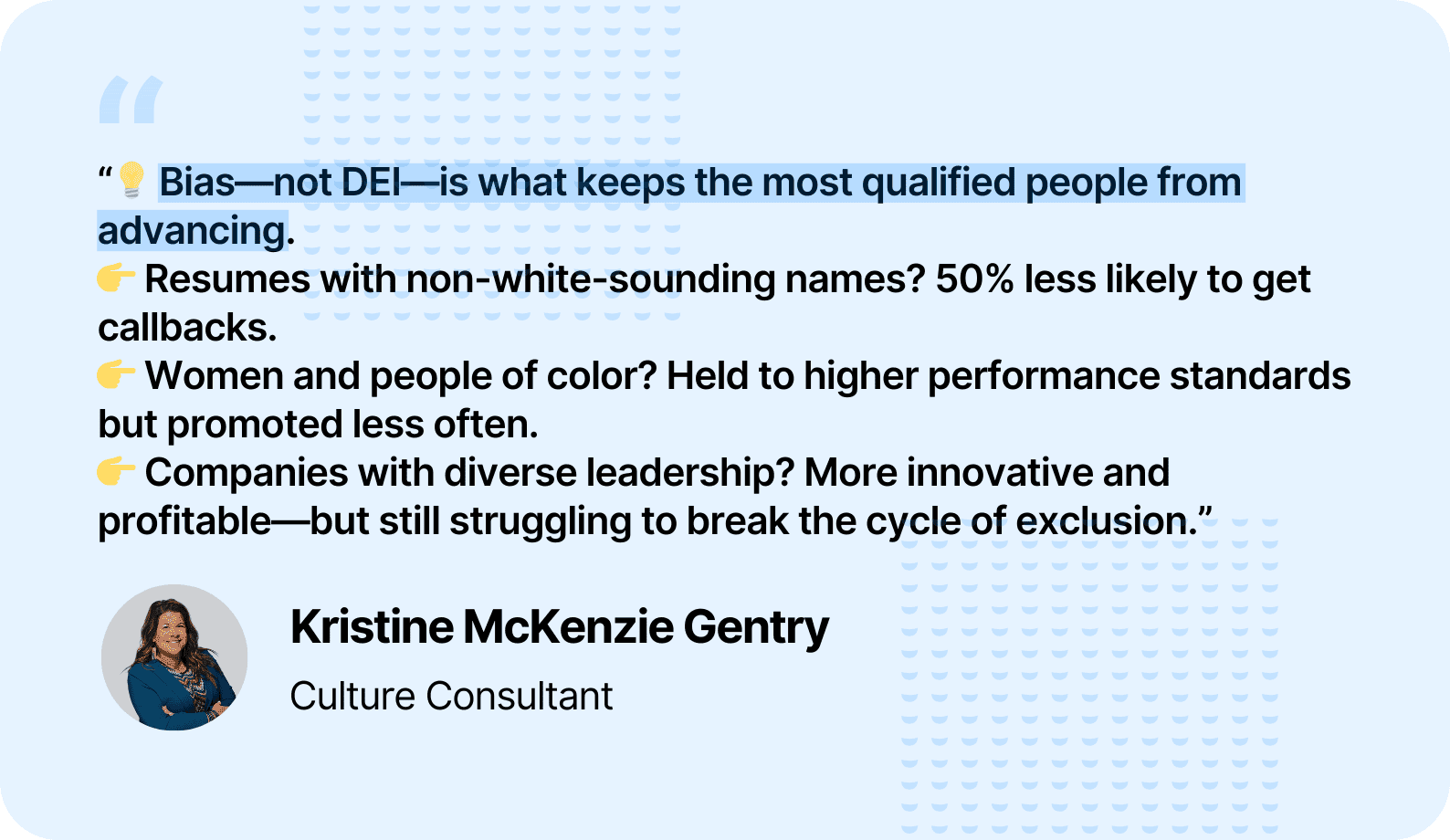
These patterns are rarely visible in a single decision, but they become undeniable over time.
Performance feedback is one of the most powerful tools shaping careers, and one of the easiest places for bias to hide.
Employees from marginalized racial groups are more likely to receive feedback focused on tone, attitude, or personality rather than outcomes. Descriptors such as aggressive, unpolished, or not a cultural fit appear disproportionately and are difficult to challenge without clear benchmarks.
Microaggressions are subtle comments or behaviors that signal exclusion. Examples include repeatedly mispronouncing names, making jokes about cultural traits, questioning someone’s competence, or treating someone as an outsider.
Individually, these moments may seem minor. Over time, they shape a work environment where employees feel constantly scrutinized or unwelcome. The impact accumulates quietly.
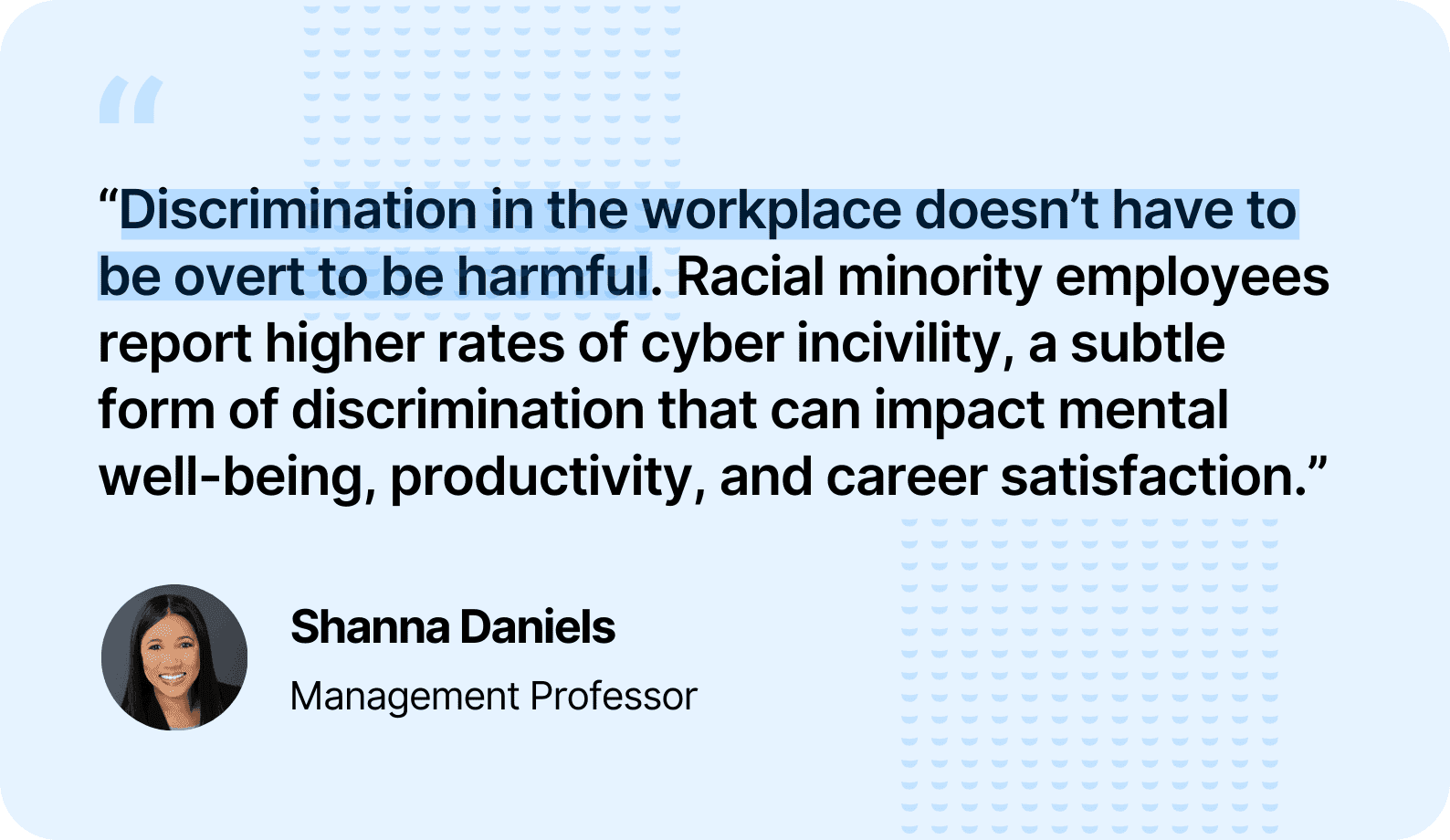
Subtle patterns of exclusion at work are part of broader workplace culture and can be addressed by active monitoring. Whistleblowing tools help organizations identify these patterns before they escalate.
Racial discrimination often becomes most visible when something goes wrong.
Employees from certain racial groups may be disciplined more harshly for similar behavior or terminated under the banner of “performance issues” without prior documentation, feedback, or support. In many cases, the behavior being penalized was previously tolerated or addressed informally for others.
Inconsistent enforcement of policies is one of the most common warning signs in racial discrimination cases reviewed by the EEOC. When rules are applied unevenly, especially during layoffs, restructuring, or performance reviews, race may be a contributing factor even if it's not explicitly mentioned.
Racial discrimination doesn’t begin on an employee’s first day. It often starts before someone ever enters the workplace.
Numerous studies show that resumes with non-white-sounding names receive significantly fewer callbacks than identical resumes with white-sounding names. This disparity exists across industries and experience levels.
This remains one of the clearest examples of racial discrimination in employment. It shapes who gets access to opportunity long before performance, culture, or potential can be evaluated.
Many people assume racism only becomes illegal when it's extreme or openly hostile. In reality, the legal threshold is much lower and far more practical.
Racist behavior becomes illegal when it affects employment conditions or creates a hostile work environment. This includes repeated comments, jokes, or behaviors that interfere with someone’s ability to work, advance, or feel safe.
Importantly, the law does not require proof of malicious intent. A pattern of behavior can qualify as discrimination even if the person responsible claims they “didn’t mean it that way.”
This is one of the most searched and most difficult questions around workplace racial discrimination.
Proof rarely comes from a single incident. Instead, it emerges through patterns over time. Helpful evidence includes written communication, performance reviews, pay data, witness statements, and a clear timeline of events.
Comparisons matter. Showing that similar situations were handled differently for employees of different races is often central to discrimination claims.
Employees don’t need to prove that someone intended to discriminate. They need to show that race played a role in the outcome.
Despite strong workplace racial discrimination laws, many employees never report what they experience.
Fear of retaliation is a major factor. Others worry about career damage, social isolation, or being labeled difficult. In some organizations, employees have seen previous complaints minimized or ignored, which erodes trust in reporting systems.

This highlights the scale of the issue for African-Americans in the US. Underreporting doesn’t mean discrimination is rare. It usually means employees don’t believe speaking up will lead to meaningful change.
An increase in reported cases often raises this question.
Current data suggests that reporting is rising faster than incidents themselves. Greater awareness of employee rights and DEI, more open conversations about race, and safer reporting mechanisms all contribute to this visibility.
While uncomfortable, increased reporting is often a sign of progress. It suggests that employees are more willing to name unfair treatment rather than absorb it silently.
Understanding your rights is important, but knowing what to do in practice matters just as much.
When racial discrimination occurs, employees should begin by documenting what happens. Dates, language used, witnesses, and patterns over time can make a critical difference later. Reviewing company policies helps clarify formal options and expectations.
Where possible, employees should use internal reporting channels. Anonymous reporting options can reduce fear of retaliation and make it easier to raise concerns early. If internal processes fail, employees can file a charge with the EEOC, keeping in mind that strict time limits apply.
For employers, how a report is handled often matters more than the final outcome.
Effective responses start with taking every report seriously. Minimization, defensiveness, or premature conclusions send a clear message that speaking up is unsafe. Investigations should be independent, especially when managers are involved, and should focus on facts rather than protecting reputations.
Many organizations are now adopting anonymous reporting tools, including platforms like FaceUp, not to invite complaints, but to surface issues early, identify patterns, and address risk before it escalates.

Prevention isn’t about perfect behavior, but about building systems that reduce bias and respond quickly when harm occurs.
Organizations that make progress tend to audit pay and promotion data regularly, standardize performance criteria, train managers using real workplace scenarios, and provide reporting channels employees trust.
Regular checks on how to prevent workplace discrimination help ensure that policies aren’t just words on paper but actively reduce bias.
Employees notice patterns quickly. Trust grows when actions consistently match stated values, especially in moments of conflict.
Racial discrimination in the workplace is rarely the result of a single bad actor. More often, it reflects systems that allow bias to persist and voices to go unheard. Addressing it requires more than policies. It requires listening, documenting, acting, and building structures people believe in.
Book a demo to see how FaceUp helps organizations surface issues early and address racial discrimination in the workplace with confidence.
Keep Reading
Alaa El-Shaarawi2026-10-0510 min
Legal & Compliance
Alaa El-Shaarawi2026-10-028 min
Legal & Compliance
Alaa El-Shaarawi2026-09-249 min
Legal & Compliance
Alaa El-Shaarawi2026-09-095 min
Legal & Compliance