

Workplace Environment

Alaa El-Shaarawi
Copywriter and Content Manager
Published
2026-01-15
Reading time
8 min

Table of contents
Subscribe to our newsletter

Mental health at work used to sit in the “nice to have” category. Today, it sits squarely in risk management, governance, and leadership accountability.
Burnout, stress, role confusion, poor support, and silence after something goes wrong are no longer soft signals. They’re predictors of absenteeism, attrition, incidents, and reputational damage. Regulators know this. Employees feel it. Boards are starting to ask questions.
That’s why ISO 45003 exists.
This guide is written for people who actually have to make the standard work. HR leaders, OHS managers, compliance teams, ESG professionals, and executives who want clarity and action without jargon.
We’ll break down what ISO 45003 really means, how it connects to ISO 45001, what psychosocial risk management looks like in practice, and how to prepare for an audit using a checklist you can actually use.
ISO 45003 is an international standard that provides guidance on managing psychological health and safety at work. Formally, it’s titled ISO 45003:2021 Occupational health and safety management — Psychological health and safety at work — Guidelines for managing psychosocial risks.
In simpler terms, ISO 45003 helps organizations identify, assess, and control risks that affect mental health, just like traditional safety systems manage physical hazards.
It doesn’t replace ISO 45001. It builds on it.
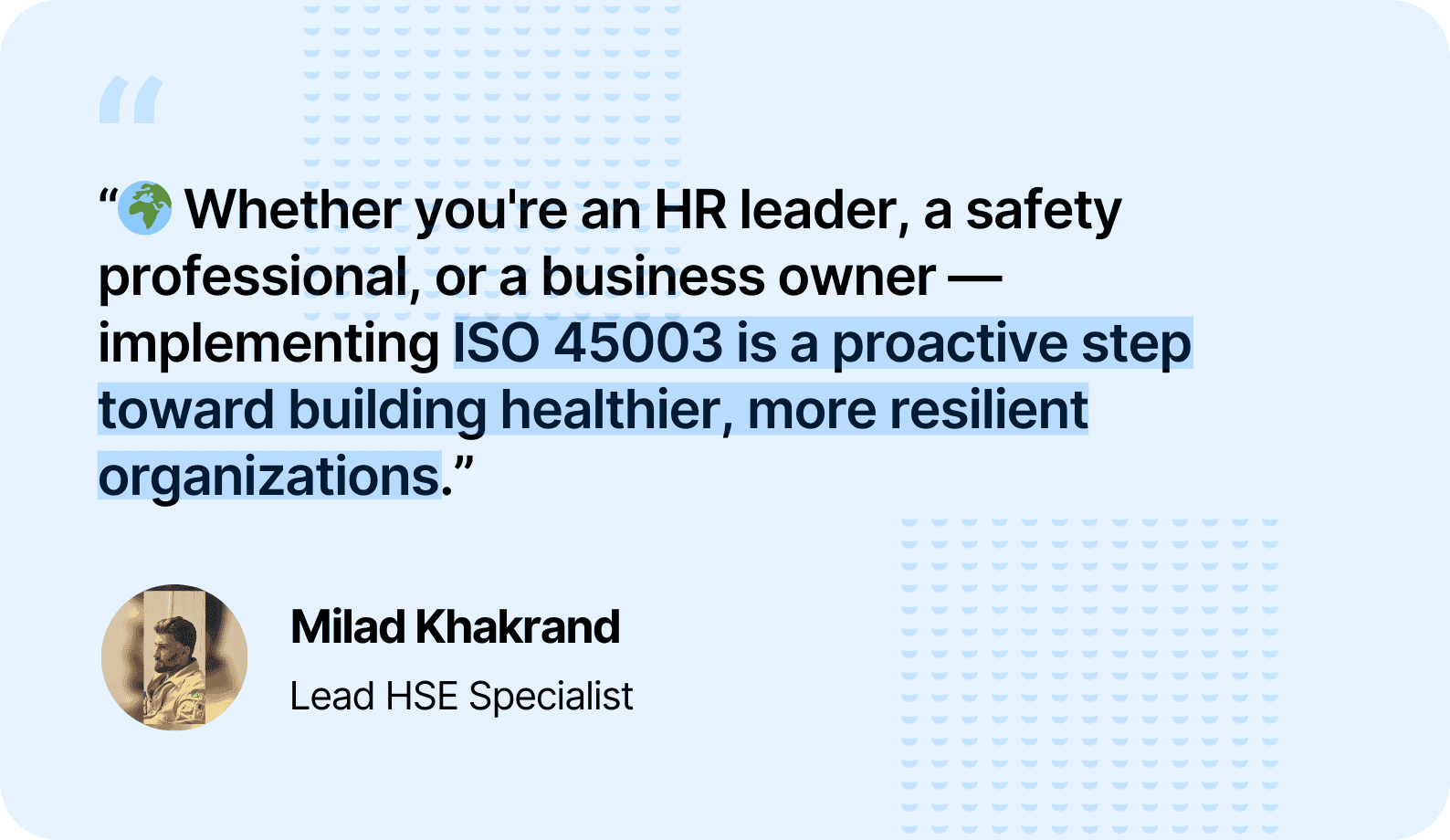
Where ISO 45001 focuses on physical harm and operational safety, ISO 45003 zooms in on how work is designed, managed, and experienced by people. This includes stress, workload, leadership behavior, role clarity, job security, harassment, isolation, and whether employees feel safe speaking up.
The key shift is this: psychological harm is treated as a workplace risk, not an individual weakness.
The standard didn’t appear by accident.
Over the last decade, organizations have seen rising levels of burnout, anxiety, and stress related illness. The pandemic accelerated this, but it didn’t create it. It exposed systems that were already stretched.
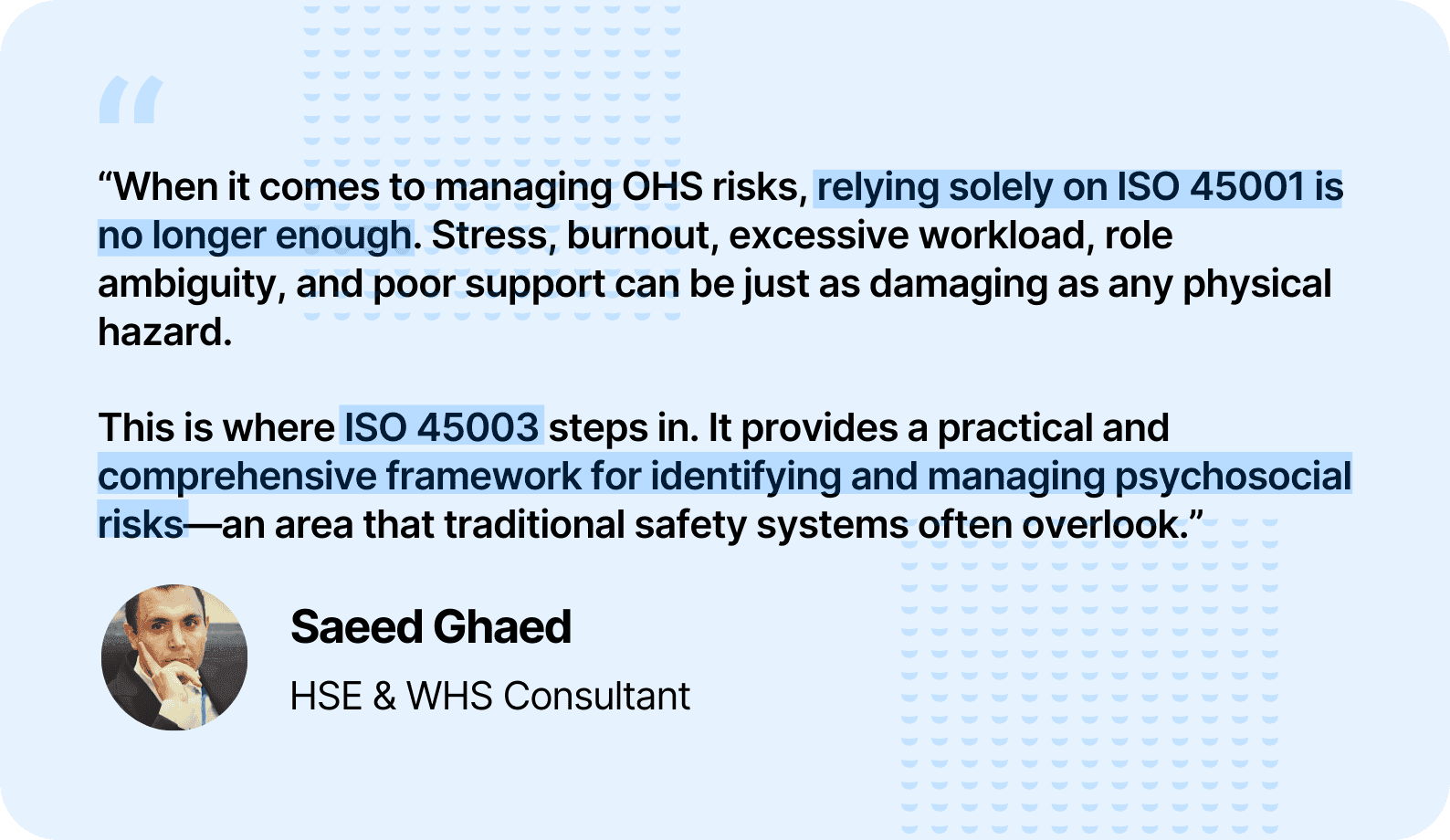
Traditional OHS frameworks struggled to deal with these risks because they’re less visible and harder to measure. You can’t put a guardrail around excessive workload. You can’t PPE your way out of toxic leadership.
ISO 45003 exists because mental health has become a material business risk, and organizations need a structured way to manage it. It also reflects a broader shift toward ESG, sustainability, and human-centered governance. Psychological health is now part of how responsible organizations are evaluated.
One of the most common questions is what size of organization uses ISO 45003.
The answer is simple—organizations of all sizes.
The standard is intentionally flexible. A 50-person startup and a multinational healthcare provider won’t implement it the same way, but both can use it meaningfully.
ISO 45003 is relevant for:
If people work for you, psychosocial risks exist. The question is whether you manage them deliberately or reactively.
Psychosocial risks are aspects of work that have the potential to cause psychological or physical harm. ISO 45003 defines these risks broadly, because they often emerge from systems, not single events.
Common examples include:
These risks rarely exist alone. They compound over time and affect both mental and physical health. Understanding psychosocial risks is the foundation of ISO 45003 psychosocial risk management.
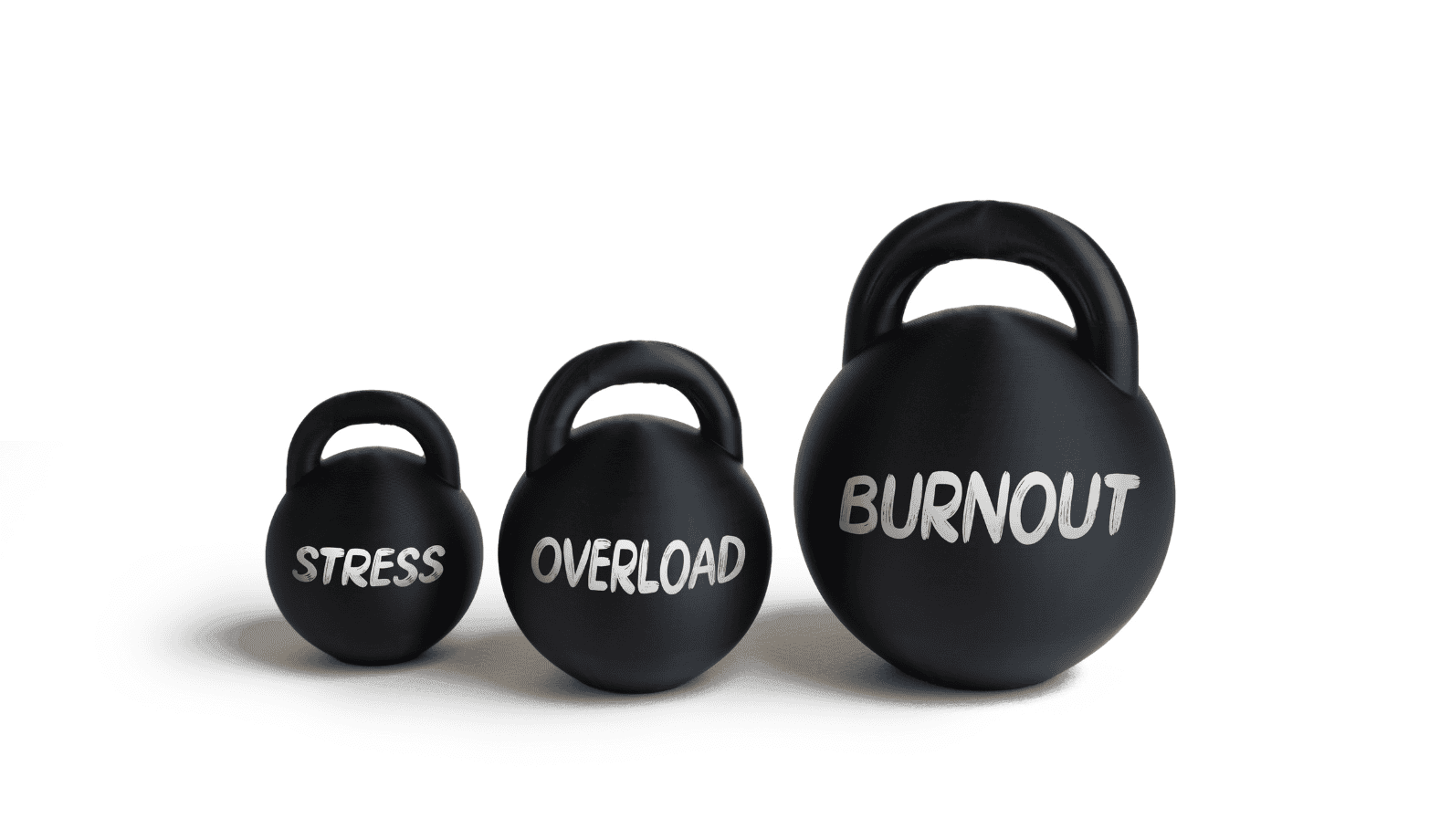
Psychological health and safety means protecting workers from harm caused by how work is designed, organized, and managed.
It also means creating conditions where people feel safe to:
This links directly to psychological safety, which FaceUp defines as the belief that you can speak up without fear of punishment or humiliation. When people stay silent, risks grow.
ISO 45003 treats psychological safety as a risk control, not a cultural slogan. It provides guidance on the management of psychosocial risks, making it part of daily operations rather than a one-off exercise.
When implemented properly, ISO 45003 helps organizations:
A frequent source of confusion is the difference between ISO 45001 and ISO 45003.
ISO 45001 focuses on occupational health and safety management systems. It addresses physical hazards, operational risks, and safety processes.
ISO 45003 provides guidance specifically for managing psychosocial risks within an ISO 45001 framework.
Think of ISO 45001 as the structure and ISO 45003 as the lens that brings mental health into focus. ISO 45003 doesn’t require separate certification. It strengthens your existing system.
ISO 45003 compliance isn’t legally mandatory on its own.
However, many national regulators now expect organizations to manage psychosocial risks, and ISO 45003 is increasingly used as the benchmark for what “reasonable” looks like.
In practice, this means:
Organizations that ignore it risk falling behind both regulators and employee expectations.
ISO 45003 doesn’t introduce rigid rules. Instead, it outlines expectations across several core areas. Each of these areas deserves deliberate attention, not surface-level policies.
Psychosocial risk management starts at the top. Leaders are expected to understand how their decisions affect mental health. This includes workload planning, change management, and how concerns are handled.
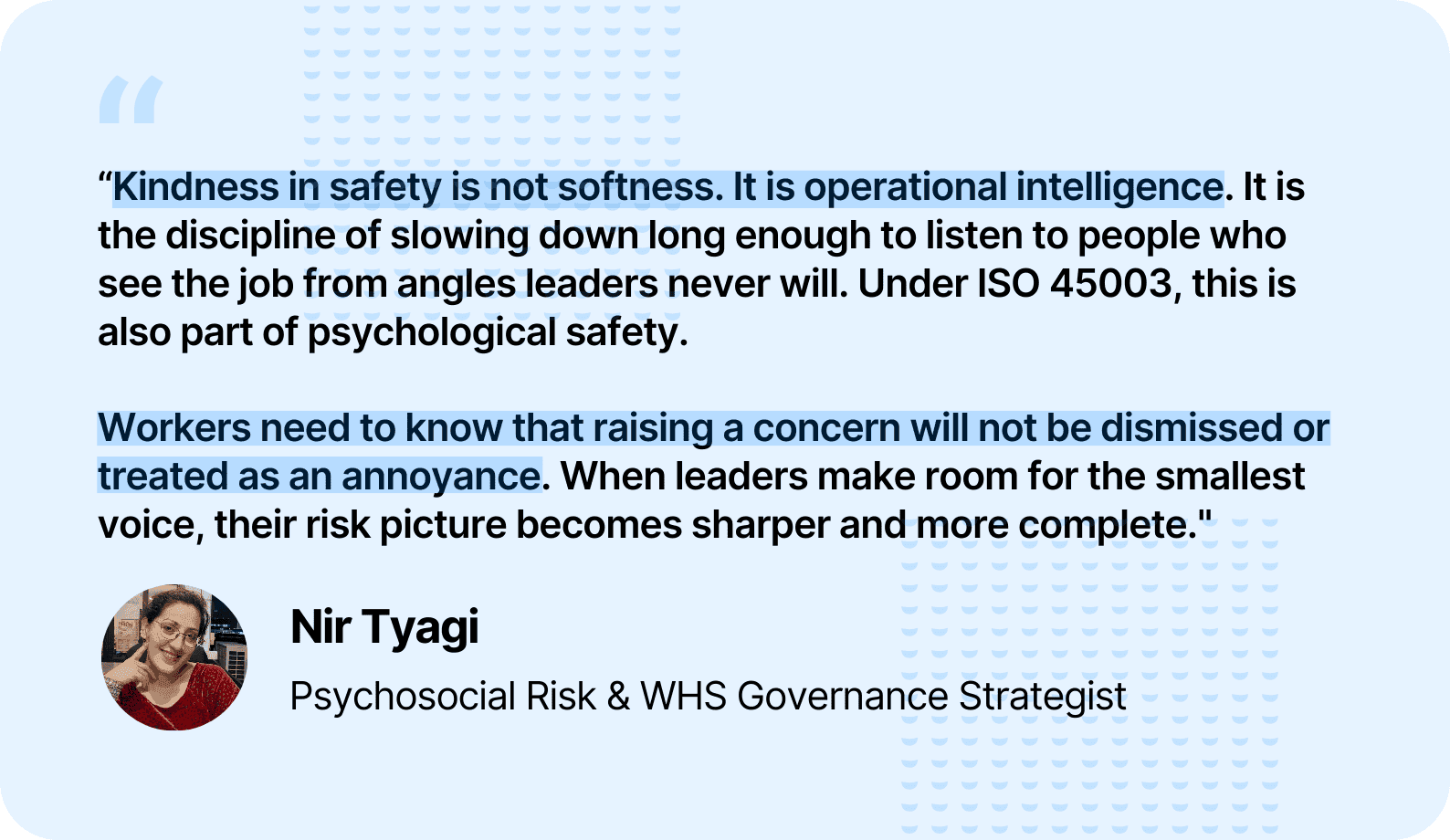
Employees must be involved in identifying risks and shaping controls. This is where many organizations struggle. Surveys alone aren’t enough. People need safe channels to speak honestly.
Anonymous reporting tools, listening mechanisms, and follow-up matter here. FaceUp often shows up not as a product, but as part of a broader listening ecosystem that helps reduce fear and silence.
Psychosocial hazards should be identified proactively, not only after incidents. This includes reviewing data such as:
Risk assessment in psychology focuses on likelihood and severity, just like physical risk assessment. The difference is context. You assess how often a risk occurs, who is exposed, and what harm could result over time.

The goal is prevention first, support second. Controls may include:
Psychosocial risks change, which means your controls must evolve. ISO 45003 emphasizes continual improvement through regular review, worker feedback, and performance evaluation.
Below is a practical ISO 45003 audit checklist you can use to assess readiness.
Implementing ISO 45003 has practical advantages for organizations that go beyond compliance:
ISO 45003 turns mental health from a reactive concern into a strategic, manageable part of daily operations.

ISO 45003 is powerful, but it has limitations.
It does not tell you exactly what to do.
That frustrates teams looking for a checklist only approach.
It depends on honesty.
If people do not feel safe speaking up, risks stay hidden.
It requires cultural change.
Policies without behavior change fail.
The way forward is combining structure with trust. Whistleblowing systems like FaceUp help by lowering the barrier to speak up, but leadership behavior determines whether those signals lead to change.
If the standard feels technical or heavy, start small. Start by listening. Review your data. Ask where people struggle. Make one improvement visible. ISO 45003 isn’t about perfection. It’s about progress.
ISO 45003 is a framework for seeing the risks that silently shape everyday work. It asks you to notice how decisions, culture, and systems affect mental health, and to act before issues escalate.
The real value comes from connecting policy to practice, not from having the “right” document. Small, visible steps build trust and show that leadership takes psychological safety seriously. When people feel safe to speak up, the entire organization becomes more resilient.
Start with what you can see and influence today. Listen, observe, and take one step to make psychosocial risk management tangible. ISO 45003 provides guidance, but your choices turn it into reality.
Take the Next Step
If you want to make ISO 45003 work for your team, begin by understanding where your risks actually live. A conversation, a simple assessment, or a structured listening tool can reveal issues you didn’t know existed.
FaceUp helps create a safe space for employees to raise concerns, track psychosocial risks, and act on them without adding layers of bureaucracy. Book a demo to see how human-focused risk management works in practice.
Keep Reading
Alaa El-Shaarawi2026-10-0510 min
Legal & Compliance
Alaa El-Shaarawi2026-10-028 min
Legal & Compliance
Alaa El-Shaarawi2026-09-249 min
Legal & Compliance
Alaa El-Shaarawi2026-09-095 min
Legal & Compliance