

Bring All Confidential Reports Into One Secure Place
We’ll assess your needs and recommend the right setup for anonymous reporting or surveys - aligned with your compliance or HR goals.
Workplace Environment

Alaa El-Shaarawi
Copywriter and Content Manager
Published on
Updated on
Reading time
8 min
Table of contents
Subscribe to our newsletter

Most companies talk about work ethic as a performance issue. They focus on productivity, punctuality, ownership, and accountability. But in practice, work ethic also shapes compliance culture.
Teams with strong workplace ethics are more likely to report concerns early, follow policies consistently, raise operational risks before they escalate, and protect the company from preventable failures. Teams without those foundations often normalize shortcuts, ignore warning signs, and stay silent when problems appear.
That difference matters. Most compliance failures don’t start with large-scale fraud or intentional misconduct. They start with small decisions that become accepted over time:
Over time, these patterns weaken trust across the organization. Strong workplace ethics help create a more accountable and transparent work environment. Employees understand expectations, leaders model accountability, and people feel responsible not only for results but also for how those results are achieved.
Work ethics are the standards and behaviors that guide how employees approach their responsibilities, colleagues, and decisions at work. In modern organizations, good work ethics usually include:
These behaviors influence far more than individual performance. They shape how teams collaborate, how leaders make decisions, and how organizations respond to risk. In regulated industries, especially, workplace ethics directly affect operational resilience and compliance maturity.
A company can have policies, training modules, and reporting channels in place. If employees don’t trust leadership or feel psychologically safe speaking up, those systems often fail when they’re needed most.
Understanding good and bad work ethic examples can help organizations recognize both healthy teamwork dynamics and early signs of workplace risk.
Many organizations separate ethics from compliance. In reality, they’re deeply connected. Compliance programs depend on everyday employee behavior and consistent business ethics at every level of the organization.
Policies only work when people consistently follow them. Reporting systems only work when employees trust the process enough to use them. Investigations only work when teams cooperate honestly, and managers support transparency.
Strong workplace ethics support compliance in several ways:
Employees with a strong sense of responsibility are more likely to report issues before they escalate into larger incidents. This makes early reporting one of the clearest indicators of a healthy compliance culture, as it increases visibility into operational and behavioral risks while there’s still time to address them effectively.
That includes:
In many organizations, serious compliance failures are preceded by smaller issues that were overlooked, normalized, or never formally escalated. When employees feel accountable for raising concerns, these issues are more likely to surface before they become systemic problems.
This allows organizations to investigate properly, address root causes, and reduce legal, financial, and reputational risk.
Employees are more willing to report concerns when accountability is consistently reinforced across leadership teams. A healthy speak-up culture doesn’t exist simply because a hotline is available. It depends on whether employees trust the reporting and investigation process.
Employees are far more likely to raise concerns when they believe that:
Without that trust, reporting systems often become underused, limiting an organization’s ability to identify risks early and respond before issues escalate into larger compliance failures.
Teams with strong work ethics usually maintain better documentation, follow procedures more consistently, and communicate risks more clearly across departments. These behaviors help organizations create more reliable internal processes and reduce gaps in compliance execution.
Operational consistency becomes especially important during audits, internal investigations, regulatory reviews, and periods of organizational change, where incomplete documentation or inconsistent procedures can create additional legal and operational risk.
Organizations with stronger ethical cultures are also more likely to apply policies consistently across departments, reducing confusion around expectations, escalation procedures, and accountability standards.
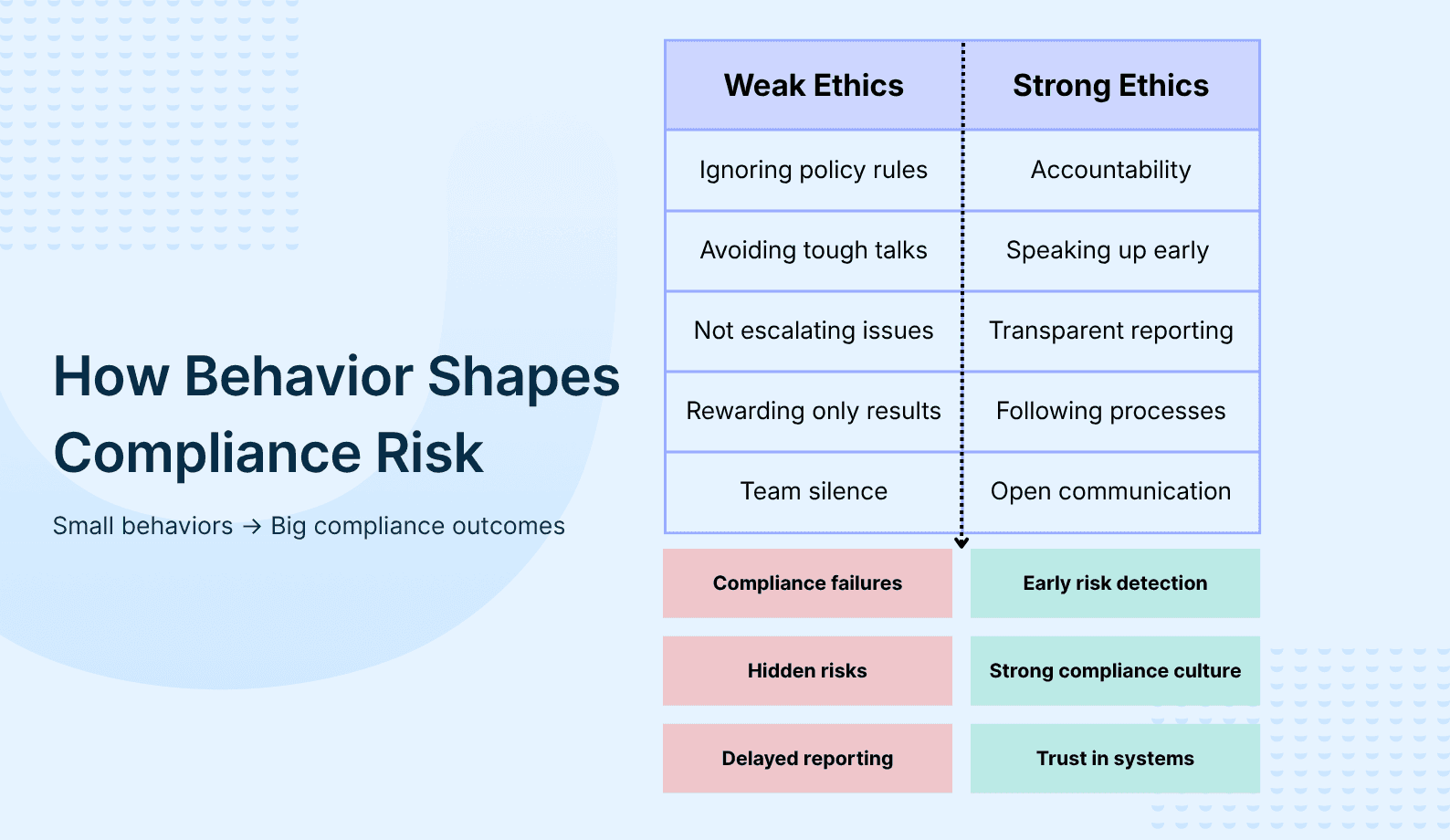
Poor work ethics rarely appear overnight. Most organizations see warning signs long before serious incidents occur. In many cases, cultural problems develop gradually through inconsistent leadership behavior, weak accountability, and unresolved employee concerns.
Common indicators include:
While these issues may appear isolated at first, they often signal deeper cultural problems that weaken trust in leadership and reduce confidence in internal reporting processes.
When these patterns continue unchecked, organizations become more vulnerable to compliance failures, lower employee morale, operational inconsistency, and reputational damage.
In many cases, the biggest risk isn’t the original misconduct. It’s the silence surrounding it.
Leadership behavior directly influences whether compliance programs function effectively. Employees closely observe how managers respond to concerns, apply policies, and handle accountability under pressure.
In environments where leadership behavior is inconsistent, employees are less likely to raise concerns or engage fully with internal reporting and investigation processes.
Organizations that successfully strengthen workplace ethics usually focus on five business practices:
Policies should explain expected ethical conduct in practical terms, not vague corporate language. Employees need clarity around:
The clearer the expectations, the easier it becomes to apply standards consistently.
Many compliance failures worsen because frontline managers respond poorly when employees raise concerns. Managers should know how to:
Manager training often has a bigger cultural impact than broad company-wide ethics presentations.
Employees are more likely to report concerns when reporting feels simple, confidential, and secure. That often includes:
The reporting experience itself influences whether employees trust the system. When reporting systems feel difficult to access, unclear, or unsafe, employees are significantly less likely to report concerns early.
Organizations often track policy completion rates while overlooking cultural indicators. More useful signals include:
These insights help organizations identify cultural weaknesses before they become major incidents. For example, sudden drops in reporting activity or repeated retaliation concerns may indicate deeper cultural problems that traditional compliance metrics fail to capture.
Ethical standards lose credibility when executives operate under different rules. Employees quickly notice inconsistencies between leadership messaging and leadership behavior.
Strong organizations investigate concerns fairly regardless of role, tenure, or seniority. That consistency builds long-term trust.
In practice, this is where many organizations struggle most: knowing how to consistently evaluate whether decisions align with ethical and compliance standards, especially under pressure.
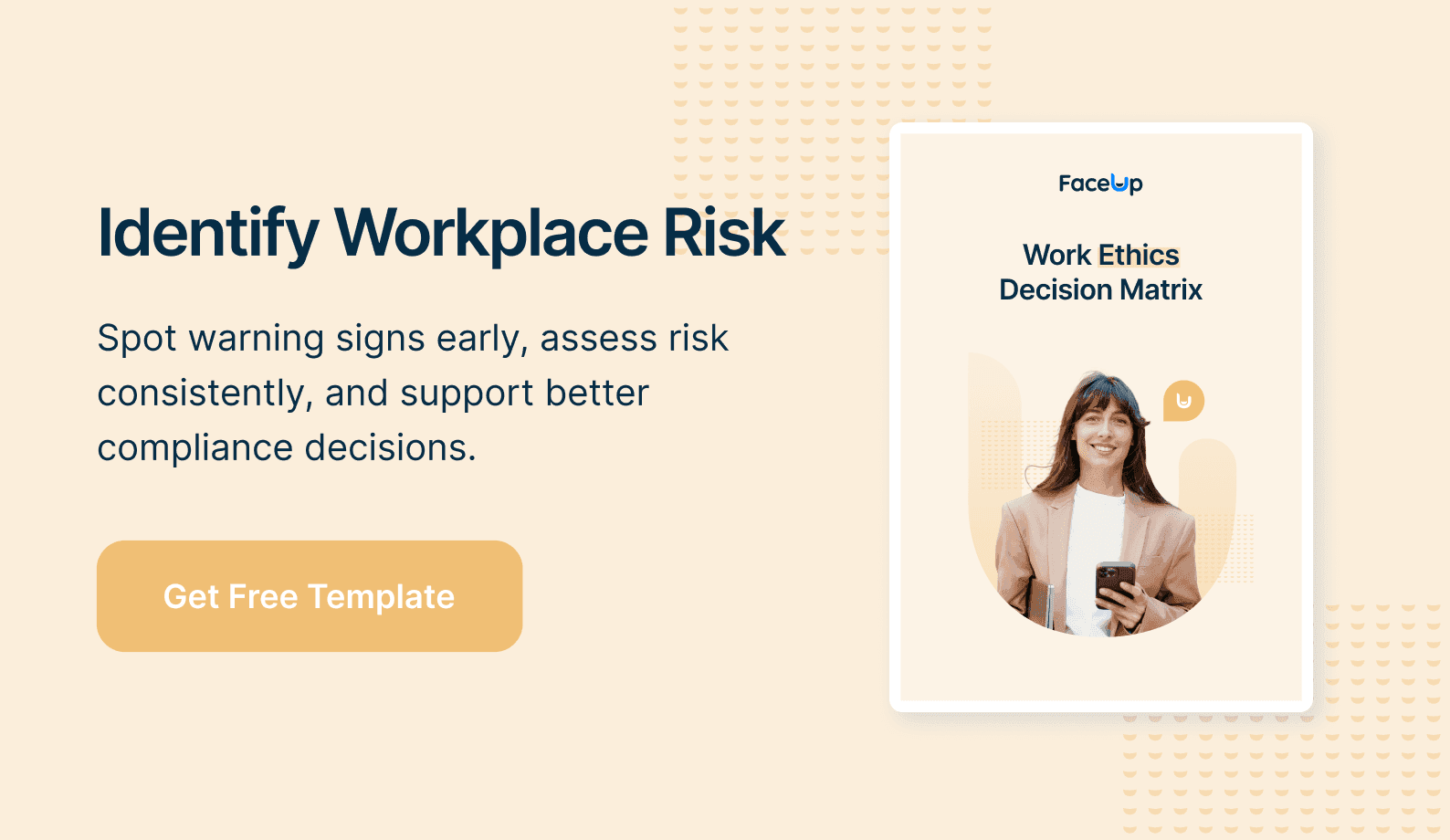
FaceUp's Work Ethics Decision Matrix helps managers and compliance teams identify early warning signs, assess workplace risk, and decide when escalation is needed.
Scenario | Early Signal | Risk Level | Response Guide |
|---|---|---|---|
Deadline slipping | Silence, vague updates, last minute changes | Medium ⟶ High | Increase visibility, clarify ownership, document impact |
Informal fixes | “Handled offline” behavior | Medium | Require documentation and traceability |
Escalation delayed | Waiting for the “right moment” | High | Strengthen speak-up culture and anonymous reporting |
The complete matrix includes 20+ additional workplace risk signals, escalation scenarios, and response frameworks designed to help teams identify issues before they develop into larger operational or compliance risks.
Many organizations assume low reporting volume means fewer issues. In reality, low reporting activity can also signal fear, distrust, or resignation. Employees often stay silent because they believe that:
This is where ethical culture and whistleblowing systems intersect. Technology alone can’t create trust. But the right reporting structure can remove friction that prevents employees from speaking up.
Anonymous reporting channels, structured investigations, and transparent case management help organizations enforce their code of ethics more consistently and respond to concerns earlier.
Modern compliance programs require more than policy documents stored in shared folders. Organizations need systems that help employees report concerns safely, help investigators manage cases efficiently, and help leadership identify patterns before risks escalate.
FaceUp’s compliance solution supports organizations by combining:
This helps strengthen accountability while creating a workplace where employees feel safer raising concerns early. For many companies, improving workplace ethics starts with improving how concerns are handled internally.
Work ethics aren’t just personal traits. They’re operational signals. They influence how employees communicate, how managers lead, how risks surface, and how organizations respond under pressure.
Strong ethical cultures reduce compliance exposure because employees understand expectations, trust reporting systems, and feel responsible for protecting the organization as a whole.
That culture is built through consistent leadership behavior, clear accountability, and systems employees actually feel confident using.
Companies that invest in those foundations are usually better prepared for regulatory pressure, workforce challenges, and long-term growth.
Book a demo to see how FaceUp helps organizations strengthen speak up culture, streamline investigations, and manage compliance reporting in one secure platform.
*This post was updated on 20/05/2026.
We’ll assess your needs and recommend the right setup for anonymous reporting or surveys - aligned with your compliance or HR goals.
Keep Reading
Alaa El-Shaarawi2026-10-0510 min
Legal & Compliance
Alaa El-Shaarawi2026-10-028 min
Legal & Compliance
Alaa El-Shaarawi2026-09-249 min
Legal & Compliance
Alaa El-Shaarawi2026-09-095 min
Legal & Compliance