

Bring All Confidential Reports Into One Secure Place
We’ll assess your needs and recommend the right setup for anonymous reporting or surveys - aligned with your compliance or HR goals.
Legal & Compliance

Alaa El-Shaarawi
Copywriter and Content Manager
Published on
Reading time
10 min

Table of contents
Subscribe to our newsletter

Most people think harassment laws are about extreme behavior. Physical assault. Explicit threats. A manager demanding sexual favors. But that’s not how most workplace harassment actually looks.
It looks like jokes that never quite land. Messages sent after hours that feel personal but unwanted. Comments about age, accent, gender identity, or sexual orientation. It looks like being ignored in meetings, sidelined from projects, or slowly pushed out of a team without anyone naming what’s happening.
This is where harassment law becomes confusing. And this is where organizations get exposed.
Workplace harassment law isn’t about intention. It is about impact, pattern, power, and whether the law recognizes the behavior as unlawful. And today, the law recognizes far more than many employers realize.
This guide explains what harassment laws in the workplace actually cover, which federal and state laws apply, what employers are legally required to do, and what employees can do when harassment happens. It’s written for people who want clarity, not legal theory.
This article is written for HR managers, compliance officers, DEI leaders, employment attorneys, people managers, and small business owners. It’s also for employees who are experiencing workplace misconduct and trying to understand their rights.
Most readers come here with the same challenges:
The goal here is practical understanding. Not just what the law says, but what it expects you to do.
Harassment is unwelcome conduct that’s based on a protected characteristic and is severe or pervasive enough to affect conditions of employment or create an offensive work environment.
That definition comes from federal law, but courts look at context. One comment rarely creates liability. Patterns do.
Harassing conduct can include:
Harassment can come from coworkers, managers, executives, clients, or anyone connected to the work environment. Once an employer knows or should know, they’re legally required to act.

A hostile work environment exists when harassment is severe or pervasive enough that a reasonable person would find the workplace intimidating, hostile, or abusive.
Courts look at:
This is why ignoring small signals is dangerous. Most hostile work environment claims are built from patterns that were allowed to continue.
Several federal laws form the foundation of workplace harassment law in the United States. Together, they define who’s protected, what employers must prevent, and how enforcement works when violations occur.
Harassment claims are primarily enforced by the Equal Employment Opportunity Commission (EEOC). Employees generally have 180 to 300 days to file a complaint, depending on state law. The EEOC can investigate, attempt mediation, or issue a right-to-sue letter that allows employees to pursue legal action in court.
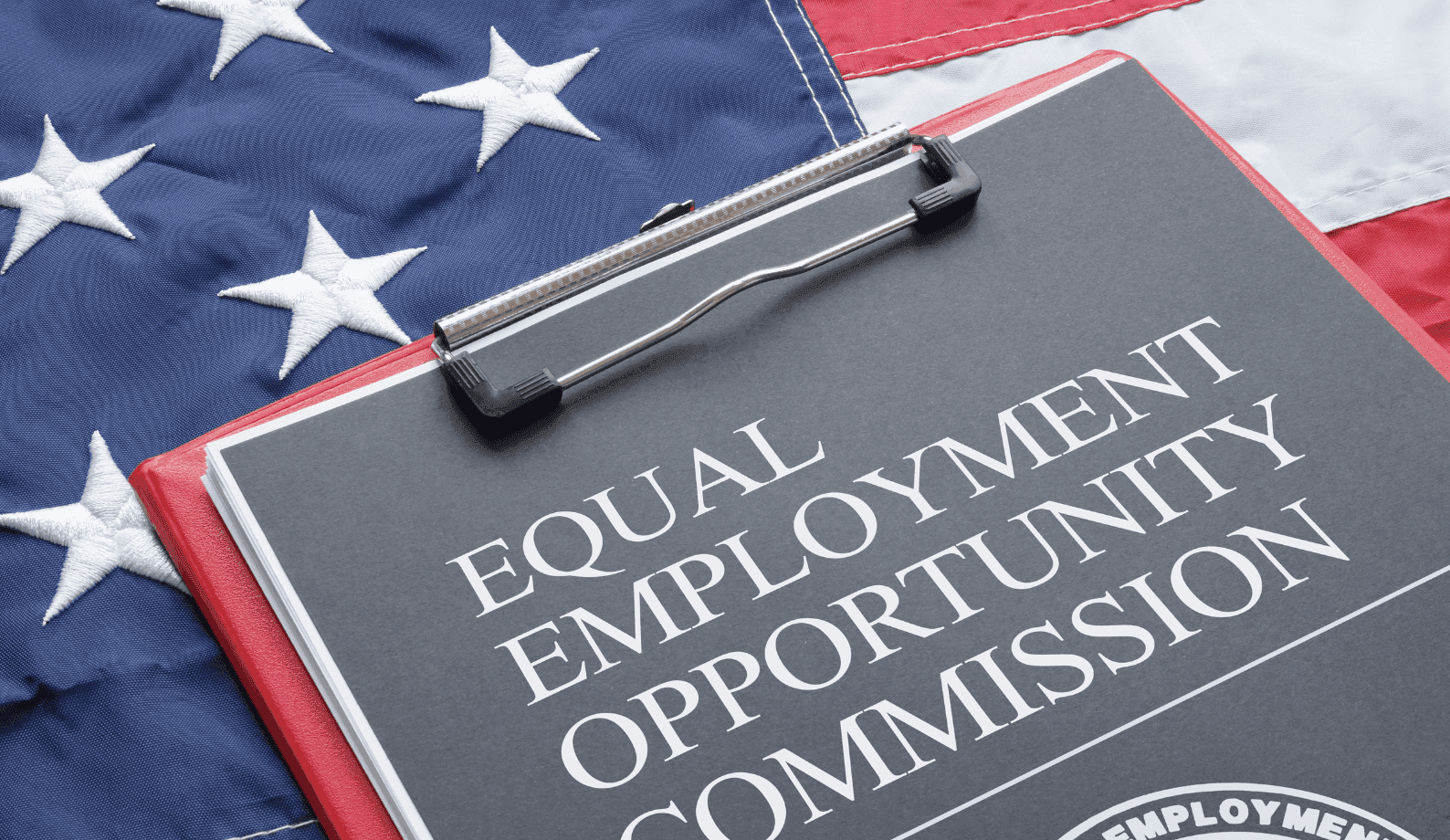
This matters for employers because harassment claims can lead to financial damages, legal fees, mandatory monitoring, policy changes, and long-term reputational harm. Courts also examine whether the employer took reasonable steps to prevent and correct harassment, not just whether a policy existed.
Title VII prohibits harassment and other forms of employment discrimination based on race, color, religion, sex, national origin, sexual orientation, and gender identity. It applies to employers with 15 or more employees and covers:
Under Title VII, employers can be held liable for harassment by supervisors even if leadership wasn’t aware, and for coworker harassment if they knew or should have known and failed to act.
The ADA protects employees from harassment based on disability and requires reasonable accommodations. Mocking, exclusion, denial of accommodations, or hostile behavior toward disabled employees can all violate the law. Employers that ignore accommodation requests or tolerate hostile treatment face direct liability.
The ADEA protects workers aged 40 and older from age-based harassment and discrimination. Repeated age-related jokes, exclusion from projects, or pressure to retire can all qualify when they affect employment conditions.
GINA prohibits harassment based on genetic information, including family medical history or inherited conditions. While less common, violations still carry legal risk and enforcement consequences.
While OSHA doesn’t explicitly regulate harassment, it requires employers to provide a safe work environment. Increasingly, harassment, bullying, and chronic stress are recognized as workplace hazards.
Federal law sets the minimum standard. State laws often raise it, sometimes significantly.
For multi-state employers, this is where compliance becomes difficult. One state may require training, another may expand protected classes, and another may lower the legal threshold for what qualifies as harassment. Employers must comply with the strictest applicable standard, not the easiest.
Some states:
California requires mandatory training, covers more protected classes, and applies a lower standard for harassment claims. Employers must also demonstrate proactive prevention, not just reaction.
New York law applies to all employers regardless of size and requires annual anti-harassment training. The legal standard is more employee-friendly than federal law, making early reporting and documentation essential.
Texas follows federal law closely but has expanded reporting timelines and clarified employer responsibilities in recent years. This means employers operating across states can’t rely on a single policy to stay compliant.
If your organization operates internationally, harassment obligations don’t stop at national borders. Across the European Union, employers are required to prevent harassment and discrimination under EU equality directives, occupational safety rules, and national labor laws that implement them.
While enforcement and definitions vary by country, the expectation is consistent: employers must provide safe working conditions, clear reporting channels, and effective remedies when harassment occurs.
The UK follows its own framework under UK harassment law, which is separate from EU rules but equally strict in practice.
Employers aren’t expected to prevent every bad interaction. They’re expected to build systems that prevent harm, detect issues early, and respond appropriately once concerns arise.
Courts and regulators look for evidence that an employer took reasonable steps, including:
When these elements are missing, employers can be held liable even if leadership claims ignorance.
Clear language, realistic examples, and simple reporting steps matter more than legal wording. Employees should know what crosses the line, how to speak up, and what happens next.
Many organizations miss details regulators care about, like whether the policy covers digital communication, applies to everyone, and offers safe reporting options. A strong anti-harassment policy closes those gaps before they become legal exposure.
Training must reflect how harassment actually happens today, including messaging apps, remote work, and power imbalances. Annual check-the-box training isn’t enough to demonstrate compliance.
Many employees fear retaliation or disbelief. That’s why regulators increasingly expect employers to offer confidential or anonymous reporting options and a clear complaint process that guides them from reporting to resolution.
This is where FaceUp plays a compliance role. Anonymous reporting tools support legal obligations by allowing employees to report concerns early, documenting issues, and creating an audit trail that shows the employer acted in good faith.
Once a complaint is received, employers must investigate quickly, fairly, and consistently. “Promptly” generally means days or weeks, not months.
Investigations must be impartial, documented, and proportional to the issue. Evidence should be preserved, including messages, emails, and digital records. Delays, inconsistent outcomes, or undocumented decisions often become the strongest evidence against employers in court.
Retaliation is one of the most common EEOC violations. It includes termination, demotion, exclusion, schedule changes, reduced hours, or subtle punishment after a report is made.
Retaliation claims often succeed even when the original harassment claim fails, which is why employers must monitor treatment of employees after reporting and document all decisions carefully.
Remote work changed the work environment. The law followed.
For decades, harassment law was applied to physical offices, work sites, and company events. But courts and regulators now recognize something much simpler and more accurate. Work is no longer a place. It’s a network of connections, conversations, and shared systems.
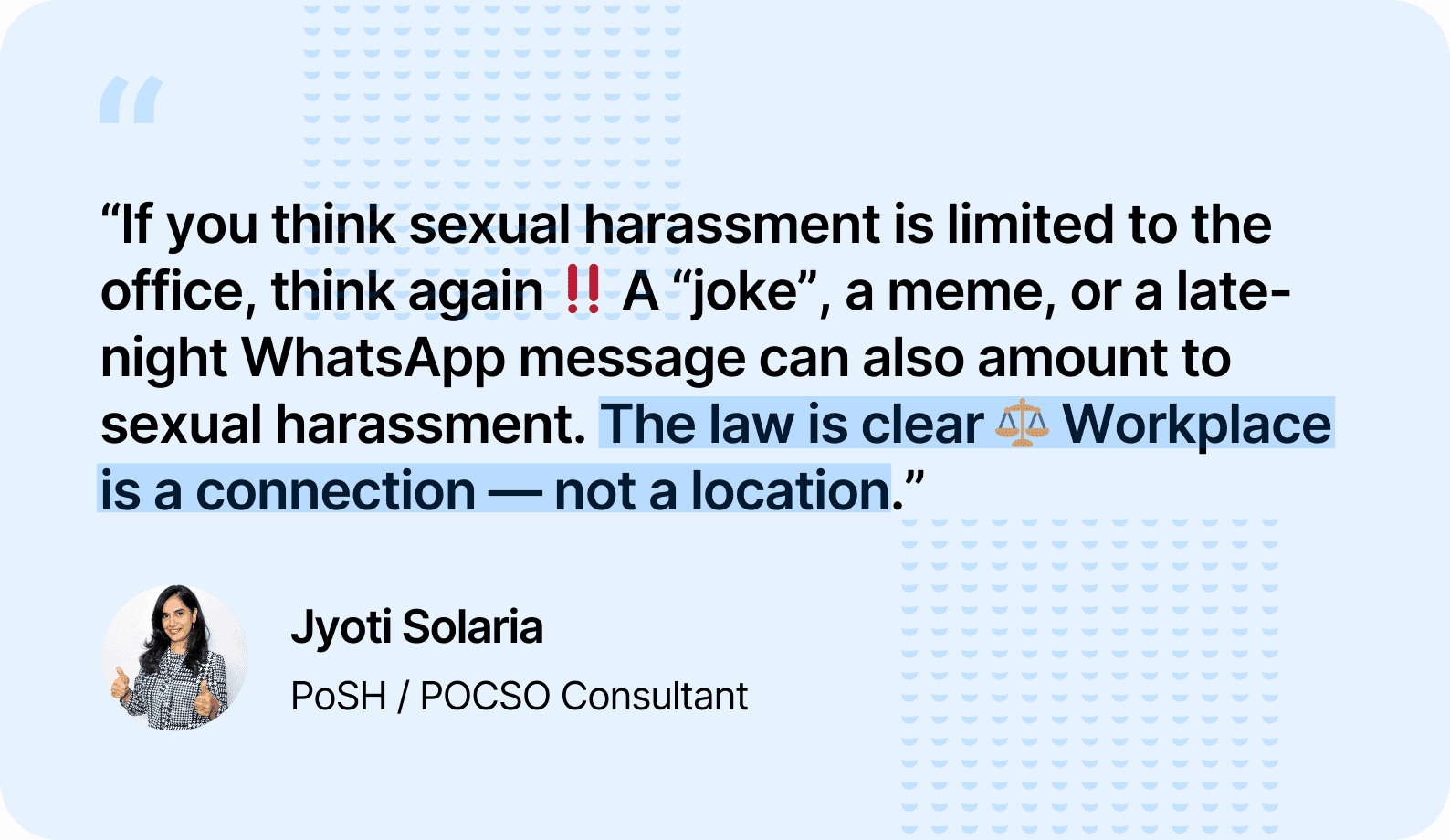
This shift matters because most harassment now happens in digital spaces where boundaries are blurry and behavior is rarely witnessed by others.
Slack messages, Microsoft Teams chats, WhatsApp groups, internal forums, social media interactions, and even emojis can all form the basis of a harassment complaint if the behavior is unwelcome and connected to work.
Courts have repeatedly confirmed that harassment doesn’t need to occur during work hours or on company-owned devices to create liability. If the interaction affects the work environment, it’s covered.
Employers are responsible for harassment that occurs:
This is where many organizations fall behind. Their policies still assume harassment happens in hallways or meeting rooms. Meanwhile, employees experience it in group chats and private messages where there are no witnesses and no clear reporting path.

From a compliance perspective, this means employers must:
Ignoring digital harassment is no longer a gray area. It’s a compliance failure.
Another common misconception is that harassment flows in one direction. It doesn’t. Harassment law has never been about gender alone. It’s always been about power. And power shows up in many forms.
Managers can harass employees. Employees can harass managers. Teams can target individuals. Senior leaders can be harassed by clients. HR professionals can become targets because of their role. Contractors, interns, and freelancers are often the most vulnerable because they sit outside traditional reporting structures.
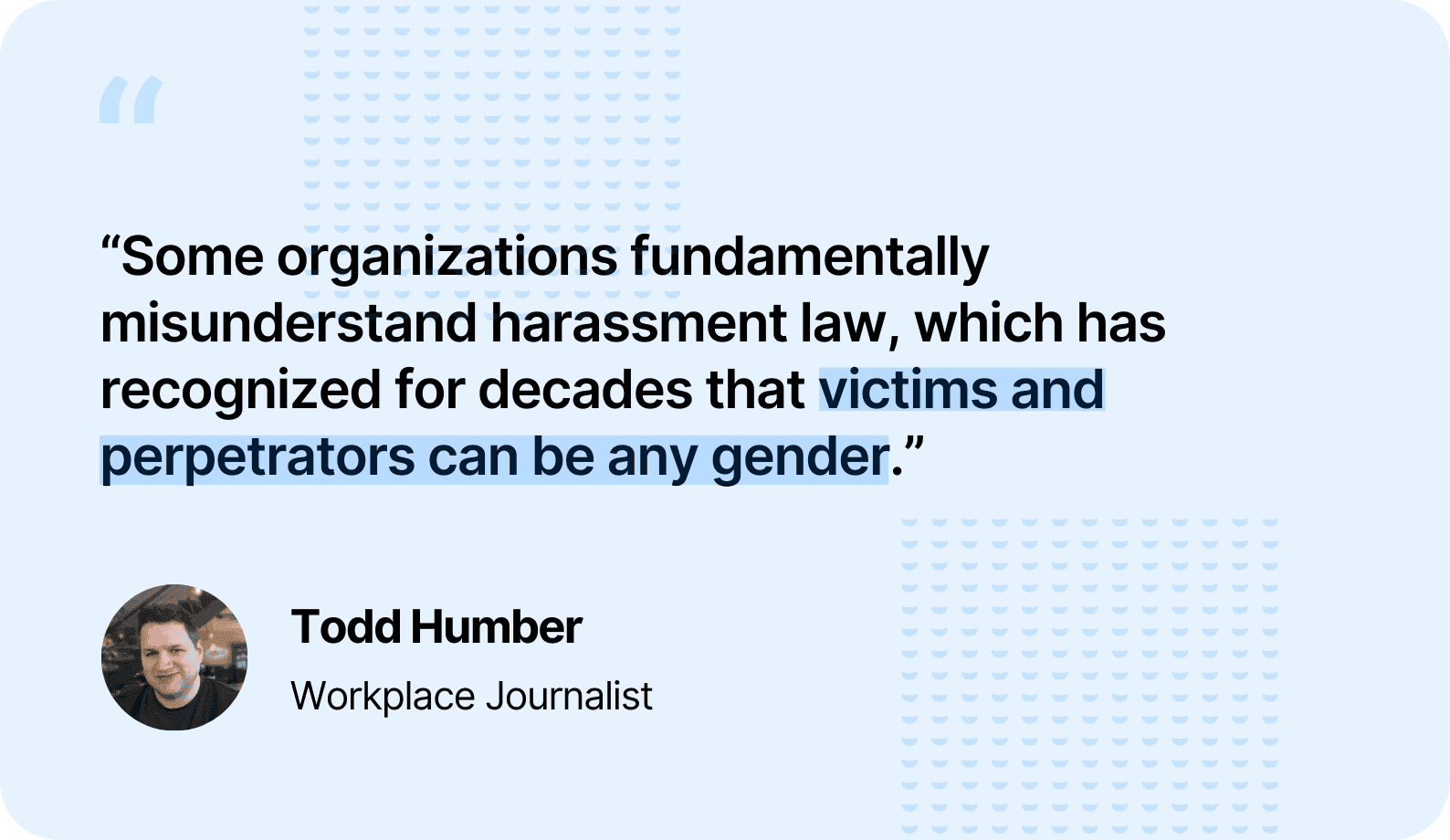
This matters because organizations often build reporting systems and training around outdated assumptions. When those assumptions fail, harassment goes unreported, investigations stall, and risk grows.
From a legal standpoint, employers are responsible for harassment when they know or should know about it, regardless of who the harasser is. That includes harassment by:
When reporting systems are designed only for one type of scenario, they create blind spots. And blind spots are exactly where lawsuits begin.
This is why modern compliance requires multiple reporting channels, clear documentation, and safe ways for anyone to speak up, regardless of role or power level. When people can’t report safely, they don’t report at all. And when organizations don’t see problems early, they lose the chance to fix them before the law gets involved.
Compliance isn’t just having a policy. It’s being able to prove that you took reasonable steps to prevent and respond to harassment, wherever your teams are located. FaceUp helps employers meet these expectations by providing:
This support applies across U.S. federal and state laws, as well as international obligations, including EU and UK directives. FaceUp doesn’t replace HR or legal teams. It gives them the visibility, structure, and evidence they need to handle harassment effectively and stay aligned with legal requirements.
Enforcement is increasing. Employee awareness is rising. Silence is no longer protection.
Organizations that treat harassment law as a checkbox continue to face lawsuits, turnover, and reputational damage. Organizations that treat it as a responsibility build safer, stronger workplaces. The law sets the minimum. Culture sets the standard.
If you’re responsible for compliance, people, or risk, the next step is visibility. You can’t fix what you can't see. FaceUp helps organizations meet legal expectations, protect employees, and detect issues before they escalate into legal claims.
Book a demo to see how anonymous reporting supports harassment law compliance in real organizations.
We’ll assess your needs and recommend the right setup for anonymous reporting or surveys - aligned with your compliance or HR goals.
Keep Reading
Alaa El-Shaarawi2026-10-0510 min
Legal & Compliance
Alaa El-Shaarawi2026-10-028 min
Legal & Compliance
Alaa El-Shaarawi2026-09-249 min
Legal & Compliance
Alaa El-Shaarawi2026-09-095 min
Legal & Compliance