

Bring All Confidential Reports Into One Secure Place
We’ll assess your needs and recommend the right setup for anonymous reporting or surveys - aligned with your compliance or HR goals.
Legal & Compliance

Marie Roland
Partnership Marketing Manager
Published
2026-03-05
Reading time
7 min
Table of contents
Subscribe to our newsletter

Hiring globally used to take months. With Deel, companies can now onboard talent across dozens of countries in a matter of weeks.
That speed unlocks opportunity, but it also introduces a new kind of pressure. Growth accelerates quickly, while governance often evolves more slowly in the background.
When companies expand across borders, compliance rarely scales at the same pace as headcount. New entities open, new employment laws apply, and cultural expectations around speaking up vary widely.
Without structured, anonymous reporting and investigation processes, governance becomes fragmented, and what starts as a small gap can quietly develop into serious legal, regulatory, or reputational exposure.
This is where FaceUp comes in. Integrated with Deel, FaceUp adds the missing layer: structured reporting, investigation workflows, and centralized oversight that grows alongside your workforce rather than lagging behind it.
This article explores the real compliance risks behind rapid international expansion and explains how a FaceUp–Deel integration creates a scalable, defensible foundation for sustainable global growth.
Deel has transformed international hiring by removing operational barriers that once slowed expansion. Companies no longer need to build local entities from scratch before accessing global talent, which makes scaling across markets significantly more accessible.

However, operational simplicity doesn’t automatically translate into governance consistency. When headcount doubles across multiple jurisdictions within a short timeframe, internal compliance structures often struggle to keep up.
Each country introduces its own whistleblower protections, investigation standards, and data privacy obligations. A process that satisfies regulators in Germany may fall short in Brazil. U.S. state-level whistleblower laws add further complexity, while emerging Middle Eastern frameworks bring new documentation and reporting expectations.
Without centralized, audit-ready case management, organizations typically experience:
Fragmented reporting channels compound the issue. Regional teams may rely on local hotlines, individual inboxes, or informal escalation paths. Over time, this creates inconsistent case handling and uneven documentation standards.
A harassment complaint in Singapore might be managed differently from one in Poland, making it difficult to identify patterns, assess risk levels, or demonstrate fairness and consistency to regulators or auditors.

The operational impact is equally significant. When employees don’t trust reporting systems or are unsure how to raise concerns, issues tend to escalate quietly. By the time leadership becomes aware of misconduct, the financial and reputational consequences are often far more severe than they would have been with earlier intervention.
Deel provides robust infrastructure for contracts, payroll, benefits, and international employment compliance documentation. It enables organizations to employ people globally with clarity and efficiency.
Yet workforce administration and compliance governance serve fundamentally different purposes.
When an employee reports harassment, discrimination, fraud, or retaliation, the response must follow a structured and defensible process. That requires standardized intake forms, controlled role-based access, defined routing and escalation paths, time-stamped audit trails, and secure documentation storage.
Relying on email threads, spreadsheets, or isolated local hotlines introduces avoidable risks:
Without a dedicated case management system, organizations scaling with Deel can clearly see their workforce structure, but they lack structured visibility into emerging internal risks.
Integrating FaceUp with Deel closes this gap by adding a structured, scalable layer for whistleblowing, investigations, and case management that adapts as the organization grows.
FaceUp syncs with Deel to automatically pull employee structures, entities, and organizational hierarchies.
This direct connection removes manual updates and reduces administrative overhead, while keeping compliance structures aligned with real-time workforce changes.
As a result:
When a new entity is created in Deel, reporting channels and case routing structures adjust automatically in FaceUp. Governance scales in parallel with hiring activity.
In distributed and multicultural teams, trust in reporting systems can vary significantly. In some regions, speaking up carries professional or social risk, which discourages early disclosure.
FaceUp provides a secure, anonymous channel where employees can raise concerns without fear of retaliation. The platform supports multilingual environments and is designed for remote, cross-border teams.
Protected anonymity increases the likelihood of early reporting, and early reporting consistently reduces investigation costs and reputational impact. Anonymous reporting is therefore not only a regulatory requirement in many jurisdictions; it’s a practical risk management mechanism that supports long-term organizational stability.
From intake through resolution, FaceUp standardizes investigation workflows within a clear governance framework.
HR, Legal, and Compliance teams operate under defined roles and permissions. Every action is time-stamped. Every communication is logged. Every decision is documented in a centralized system.
This level of structured documentation becomes especially important as companies expand internationally and face greater scrutiny from regulators, auditors, and investors. The ability to demonstrate consistent, fair, and timely case handling strengthens defensibility and reinforces credibility across jurisdictions.
Global expansion requires balancing local legal obligations with centralized governance visibility.
FaceUp’s configurable workflows allow organizations to:
This combination of local flexibility and centralized insight enables companies to remain compliant in diverse legal environments while preserving consistent internal standards.
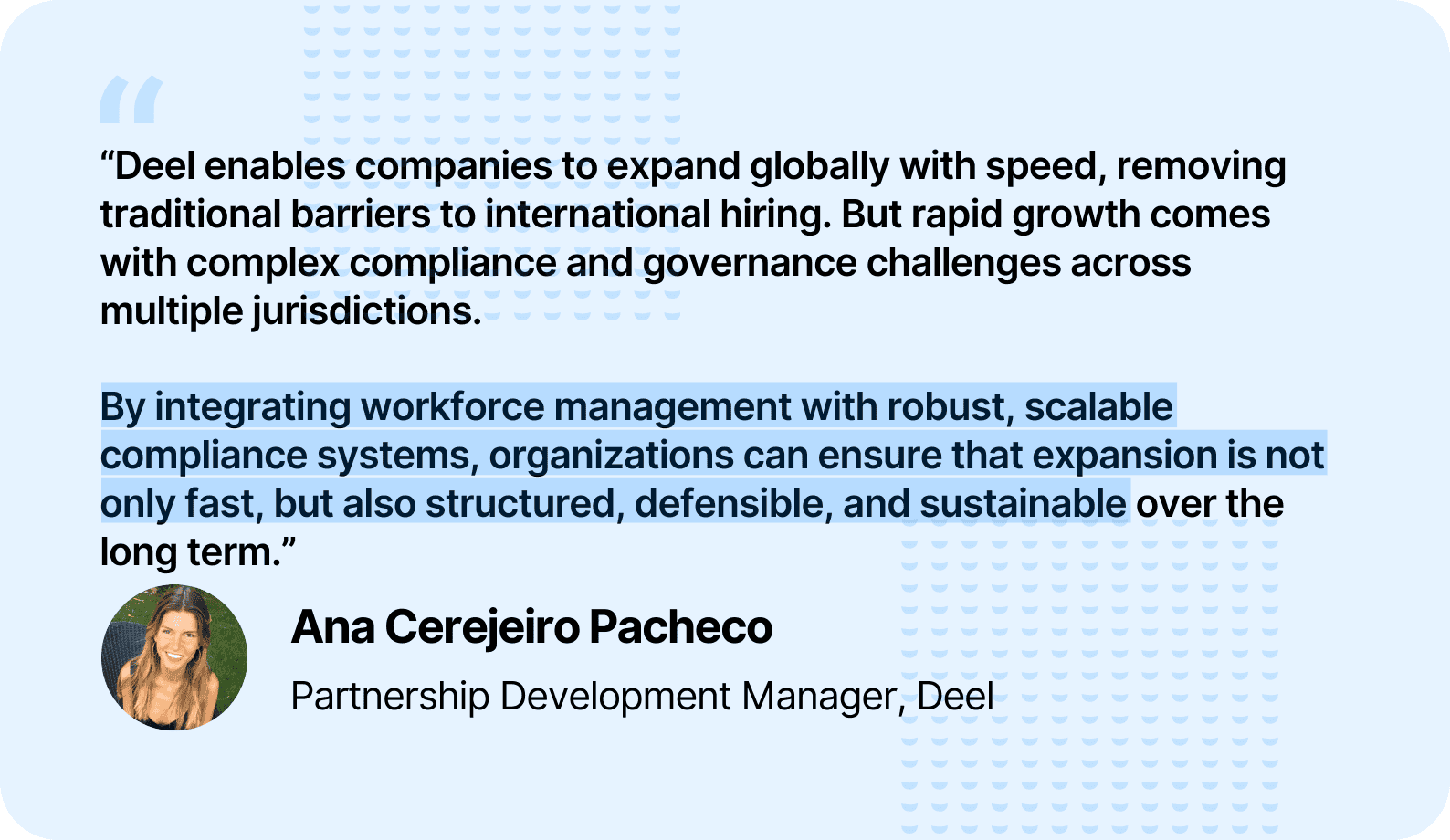
When Deel and FaceUp operate together, HR data flows directly into compliance workflows. An employee onboarded in Deel is automatically included in FaceUp’s reporting structure. When that employee exits, access permissions are updated accordingly.
This synchronization reduces manual effort, minimizes human error, and strengthens governance consistency across the organization.
Beyond operational efficiency, integration improves strategic visibility.
Instead of receiving fragmented updates from regional teams, leadership gains real-time visibility into case volume, categories of concern, geographic distribution, and investigation timelines.
This broader perspective supports proactive risk management, allowing leadership teams to respond to patterns early rather than reacting to isolated crises.
Automated routing, notifications, and documentation streamline case handling processes. Compliance teams spend less time coordinating manually and more time focusing on investigation quality, policy development, and organizational improvement.
Whether an organization has 200 employees or 2,000, the integrated system adapts without requiring significant process redesign or additional administrative headcount.
As expansion accelerates, governance remains stable rather than becoming a constraint on growth.
Companies entering new markets through Deel should treat compliance infrastructure as a strategic component of expansion planning.
Plan governance alongside hiring. Before entering a new jurisdiction, review local whistleblower protections, data privacy laws, and investigation standards, and incorporate those requirements into internal workflows from the outset.
Encourage early reporting. Lowering barriers to disclosure reduces long-term financial and reputational risk. Anonymous systems such as FaceUp help build trust across diverse cultural contexts.
Standardize case handling processes. Consistency protects employees, leadership, and the organization as a whole while simplifying audit and regulatory reviews.
Invest in systems that scale. Manual processes may function in early-stage growth but tend to break under international expansion. Integrated tools that connect HR platforms like Deel with structured case management create a more resilient operational foundation.
Deel has made international hiring accessible to companies of every size. Rapid growth across borders is no longer reserved for large enterprises with complex infrastructure.
Sustainable growth, however, requires governance to expand at the same pace as headcount.
By integrating FaceUp with Deel, organizations embed structured anonymous reporting, audit-ready case management, and cross-border compliance oversight directly into their expansion model. Governance becomes part of the operating system rather than a reactive layer added after issues arise.
For companies committed to responsible and sustainable international growth, aligning HR systems with compliance governance is a practical and necessary step.
If you are scaling with Deel and want to strengthen your compliance framework, book a demo to explore how the FaceUp–Deel integration supports global oversight.
Exclusive offer: Deel users receive 40 percent off FaceUp for the first year. Mention this offer when booking your demo to activate it.
We’ll assess your needs and recommend the right setup for anonymous reporting or surveys - aligned with your compliance or HR goals.
Keep Reading
Alaa El-Shaarawi2026-10-0510 min
Legal & Compliance
Alaa El-Shaarawi2026-10-028 min
Legal & Compliance
Alaa El-Shaarawi2026-09-249 min
Legal & Compliance
Alaa El-Shaarawi2026-09-095 min
Legal & Compliance