

Bring All Confidential Reports Into One Secure Place
We’ll assess your needs and recommend the right setup for anonymous reporting or surveys - aligned with your compliance or HR goals.
Workplace Environment

Alaa El-Shaarawi
Copywriter and Content Manager
Published
2025-02-14
Reading time
8 min
Table of contents
Subscribe to our newsletter

Work ethics are often treated as a “soft” topic; something cultural, subjective, and difficult to measure. In reality, they’re one of the clearest indicators of whether a company’s compliance systems are functioning properly or quietly breaking down.
A team is rushing to close out the quarter. A manager approves numbers that haven’t been fully verified, planning to “clean it up later.” No one pushes back. It’s faster, and everyone feels pressure to deliver.
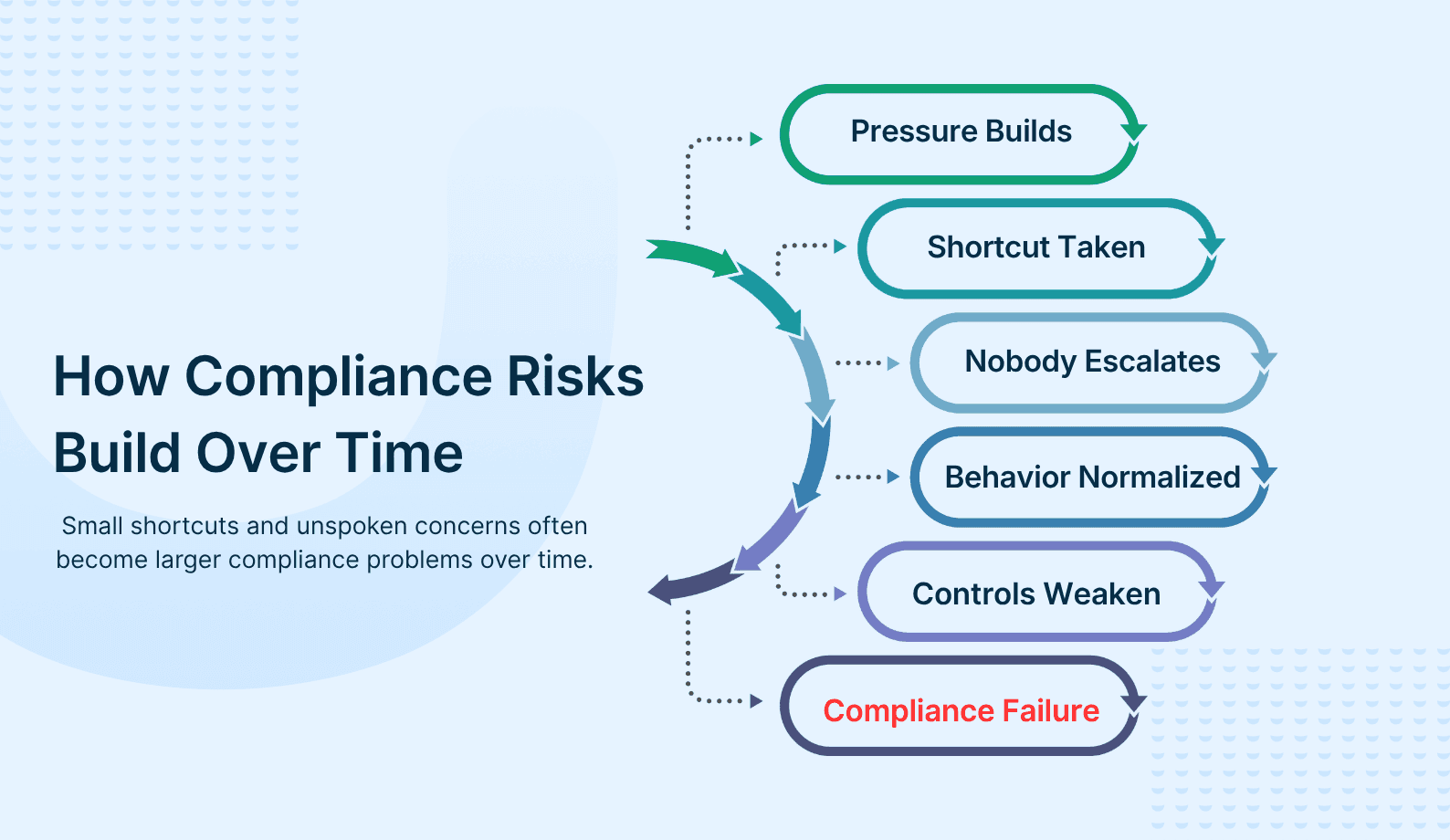
Nothing happens immediately. No alert is triggered. But the decision changes the standard slightly. The next shortcut feels easier. The next exception feels smaller. Over time, what started as a temporary compromise becomes accepted behavior.
Most serious compliance failures don’t begin with obvious misconduct. They begin with small exceptions that gradually become normalized because nobody escalates them.
This is how workplace risk usually develops. Not through one dramatic event, but through repeated moments where:
For compliance leaders, the real signal is here. It appears in how employees behave under pressure, uncertainty, conflicting priorities, or operational risk. That’s where work ethic stops being theoretical and starts becoming measurable.
It’s easy to say employees should “act with integrity.” It’s much harder to define what integrity actually looks like in everyday operational decisions.
Work ethic becomes visible in situations like:
These situations aren’t rare edge cases. They happen constantly inside organizations. The difference is usually not intent, but whether the behavior becomes visible early or stays hidden long enough to create larger risk.
That’s why work ethics shouldn’t be viewed as abstract values alone. They should be viewed as behavioral indicators of organizational health, accountability, and compliance maturity.
Rather than treating work ethic as an isolated personality trait, it’s more useful to look at the recurring behavioral patterns that shape organizational risk over time.
Most work ethic issues fall into several consistent categories:
On their own, these may appear to be small performance gaps. But when repeated across teams or ignored by leadership, they become early indicators of compliance exposure and cultural deterioration.
Category | What Good Looks Like | What Breaks Down | Why It Matters |
|---|---|---|---|
Reliability | Deadlines are visible and managed early | Delays remain hidden | Operational blind spots and reporting gaps |
Accountability | Mistakes are surfaced quickly | Errors are hidden or minimized | Misreporting and repeated failures |
Integrity | Processes are followed under pressure | Shortcuts become normalized | Control breakdown and misconduct risk |
Communication | Risks are shared openly | Information is withheld | Delayed response and poor coordination |
Compliance Awareness | Employees raise concerns early | Issues go unreported | Legal, financial, and reputational exposure |
This is where work ethics move beyond culture and become observable compliance signals.
Work ethics are easiest to describe in theory. They become much more important when pressure, ambiguity, or competing priorities enter the picture. The breakdown usually appears in several recurring situations.
A missed deadline is rarely just a scheduling issue.
More often, it reflects:
In stronger organizations, delays surface quickly. Teams communicate blockers early, document trade-offs, and adjust expectations transparently.
In weaker environments, issues stay hidden until reporting obligations are missed or operational damage becomes unavoidable.
The difference is rarely capability. It’s visibility and escalation behavior.
Every organization experiences mistakes. What matters is whether employees feel safe surfacing them quickly.
In stronger teams:
In weaker environments, employees delay escalation, soften details, or hope problems resolve quietly. From a compliance perspective, the delay between discovering an issue and reporting it is often more dangerous than the original mistake itself.
Pressure is where organizational standards are truly tested. A deadline becomes urgent. A customer complaint escalates. Performance targets increase.
This is where shortcuts begin to feel reasonable:
Individually, these decisions may seem minor. Collectively, they redefine what employees begin to accept as “normal.”
In stronger organizations, pressure doesn’t change process expectations. Employees still document decisions, follow controls, and escalate exceptions appropriately. Consistency under pressure is one of the clearest indicators of strong workplace ethics.
Many compliance failures aren’t caused by lack of knowledge, but by lack of shared visibility.
Someone notices a risk but assumes another team already knows. A manager avoids escalation to prevent conflict. Teams operate with inconsistent assumptions because communication never becomes formalized.
The gaps may appear small individually, but they compound quickly into operational and compliance blind spots.
In stronger organizations, expectations are explicit:
This reduces hesitation and creates a more consistent organizational response.
One of the strongest indicators of workplace ethics is what happens when employees notice something is wrong. In healthy environments, concerns are raised early because employees trust:
In weaker environments, silence becomes normalized. Employees often stay silent not because they don’t care, but because they’re uncertain whether reporting will lead to meaningful action.
That uncertainty is where organizational risk compounds. Silence is rarely an awareness problem. It’s usually a trust problem.
Work ethics shape how risks emerge in day-to-day decisions. Whistleblowing systems determine how those risks are formally reported, investigated, and resolved. Together, they form the backbone of modern compliance systems.
Learn how this works in practice in our Whistleblowing in the Workplace Guide.
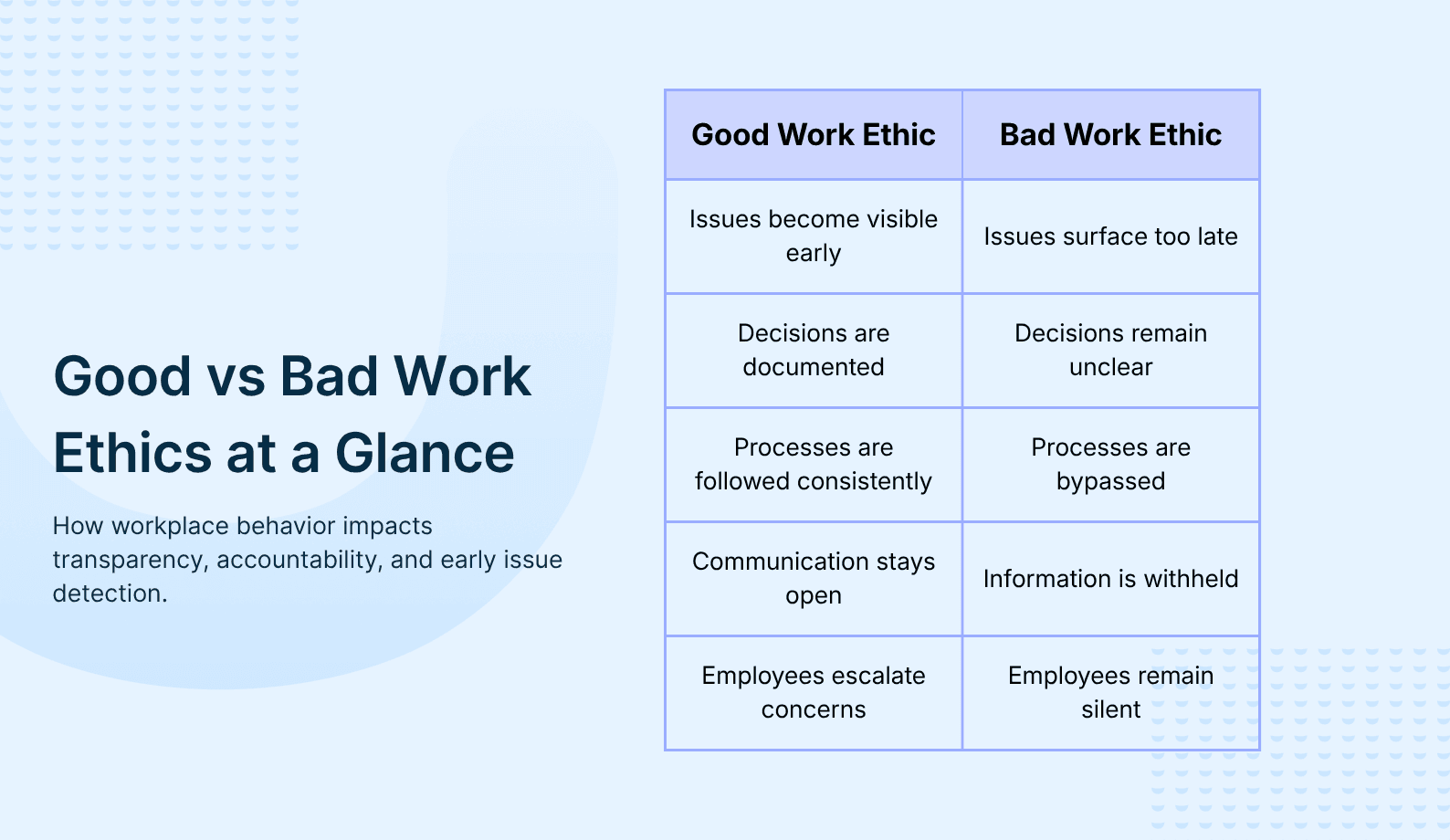
Over time, these behaviors reinforce each other and shape the organization’s overall risk culture.
FaceUp's Work Ethics Decision Matrix helps managers and compliance teams identify early warning signs, assess workplace risk, and decide when escalation is needed.
Scenario | Early Signal | Risk Level | Response Guide |
|---|---|---|---|
Deadline slipping | Silence, vague updates, last minute changes | Medium ⟶ High | Increase visibility, clarify ownership, document impact |
Informal fixes | “Handled offline” behavior | Medium | Require documentation and traceability |
Escalation delayed | Waiting for the “right moment” | High | Strengthen speak-up culture and anonymous reporting |
The complete matrix includes 20+ additional workplace risk signals, escalation scenarios, and response frameworks designed to help teams identify issues before they develop into larger operational or compliance risks.
It’s easy to assume compliance is driven primarily by policies and systems. In practice, compliance is driven by behavior.
Policies establish expectations. Systems support enforcement. But everyday employee decisions determine whether those systems function effectively in reality.
Small compromises rarely stay isolated:
This is how larger compliance failures gradually develop. Work ethics sit at the center of this process because they determine whether problems become visible before they become unmanageable.
Organizations with stronger workplace ethics tend to:
Weak workplace ethics rarely appear immediately as compliance failures. They appear first as behavioral warning signs.
What organizations often describe as “good work ethic” is actually a collection of observable workplace behaviors. These include:
Accountability means taking ownership without deflecting responsibility. It becomes visible when employees:
Strong communication is when people share relevant information at the appropriate time, especially when conversations are uncomfortable or operationally sensitive. It becomes visible when employees:
Ethical decision-making is reflected in how consistently people act under pressure. It becomes visible when employees:
Compliance awareness is demonstrated when employees understand when formal rules, policies, or obligations apply in day-to-day work. It becomes visible when employees:
Together, these behaviors determine how quickly organizations detect risk and how consistently they respond once issues emerge.
Not every workplace issue requires formal escalation. However, organizations need clear boundaries between:
Generally, performance issues can be managed within teams. On the other hand, issues involving potential harm, misconduct, or legal exposure usually require escalation. These include:
Most serious issues begin as smaller behavioral signals long before they become formal violations. That’s why early reporting matters.
In global organizations, workplace ethics aren’t always interpreted consistently.
Attitudes toward:
can vary significantly across regions and cultures.
In some environments, speaking up feels expected. In others, escalation may feel uncomfortable or professionally risky. Without clear organizational standards, the same workplace issue may be handled very differently across teams or regions.
That’s why organizations must clearly define:
The goal isn’t to remove cultural differences. The goal is to create consistent ethical expectations across the organization.
Work ethics only matter operationally when concerns can be surfaced, investigated, and resolved consistently.
Even in strong workplace cultures, employees hesitate. They may notice concerns but remain uncertain about:
Without structured reporting systems, many early warning signs never become visible to compliance or leadership teams. This is where formal reporting and case management systems become essential.
FaceUp helps organizations:
This turns workplace behavior into something organizations can actually monitor, investigate, and improve over time.
Book a demo to see how FaceUp helps organizations turn early behavioral signals into structured compliance action.
*This post was updated on 15/05/2026.
We’ll assess your needs and recommend the right setup for anonymous reporting or surveys - aligned with your compliance or HR goals.
Keep Reading
Alaa El-Shaarawi2026-10-028 min
Legal & Compliance
Alaa El-Shaarawi2026-09-249 min
Legal & Compliance
Alaa El-Shaarawi2026-09-095 min
Legal & Compliance
Mary Shirley2026-07-285 min
Workplace Environment