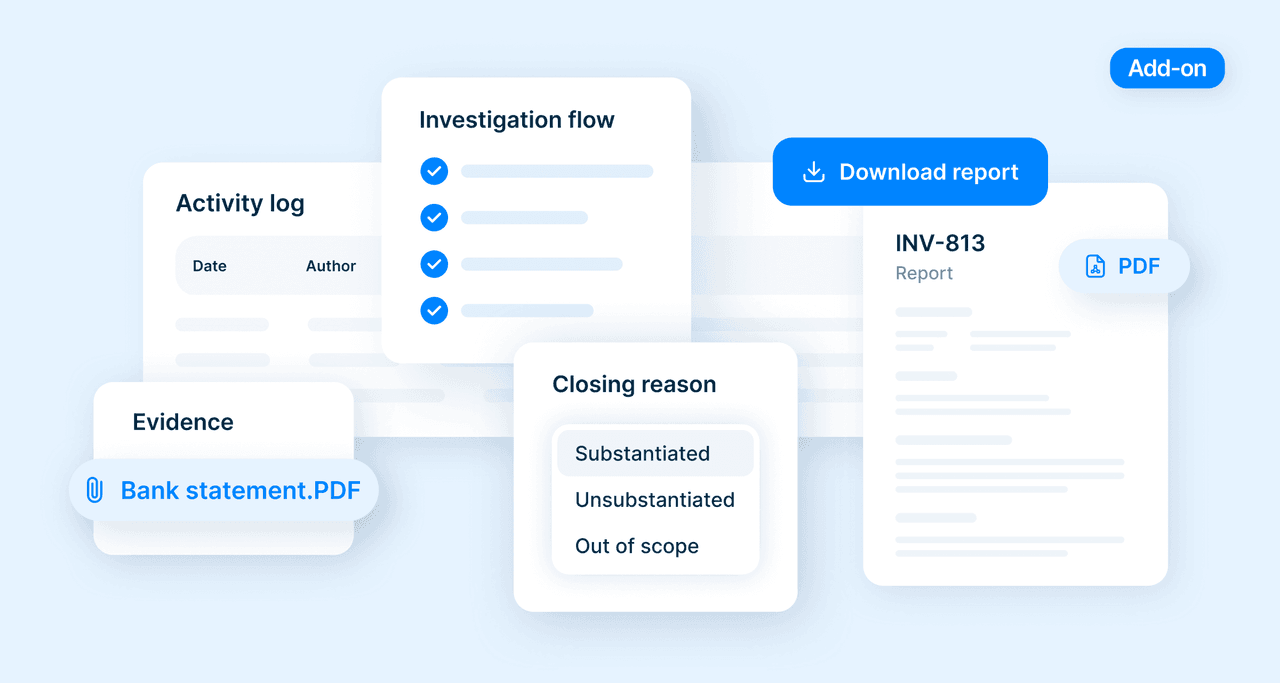


Bring All Confidential Reports Into One Secure Place
We’ll assess your needs and recommend the right setup for anonymous reporting or surveys - aligned with your compliance or HR goals.
Legal & Compliance

Alaa El-Shaarawi
Copywriter and Content Manager
Published
2025-05-29
Reading time
10 min
Table of contents
Subscribe to our newsletter

Most employees don’t report workplace concerns immediately. When something feels off, they usually wait.
They look for context, check whether others notice the same issue, or try to understand how past concerns were handled before deciding whether to speak up. In some cases, they’re also weighing what might happen if they do.
That delay is important. It’s one of the reasons workplace issues often remain invisible far longer than leadership expects. By the time a concern reaches HR, compliance, or legal teams, employees have often been discussing it informally for weeks or months.
Silence in organizations is rarely sudden. It builds over time based on how safe and effective employees believe reporting really is.
People pay attention to what happens when others speak up; whether issues are addressed, outcomes are consistent, and reporting creates risk for the person who raised it. Those signals shape whether employees trust the system at all.
This is why whistleblowing isn’t just a compliance mechanism. It’s a reflection of whether employees believe the organization will handle problems fairly and consistently.
When reporting systems work well, issues surface earlier and can be addressed before they escalate. When they don’t, problems tend to surface only once they become operational, legal, or reputational risks.
For compliance and HR leaders, the challenge isn’t awareness of issues, but building enough trust that employees report them early enough to matter.
Whistleblowing happens when an employee, contractor, partner, or other stakeholder reports behavior they believe is unethical, illegal, unsafe, or seriously inappropriate inside an organization.
That may involve concerns such as harassment, discrimination, fraud, retaliation, safety violations, corruption, conflicts of interest, data privacy breaches, or serious policy violations.
Reports can be submitted anonymously, confidentially, internally, or through external authorities, depending on the situation and the reporting channels available. People often associate whistleblowing with major corporate scandals. In reality, most reports are far less dramatic.
Common examples include:
On their own, these may not appear catastrophic. The risk comes from repetition and normalization. Most serious compliance failures begin as smaller issues that employees noticed long before leadership did.
Organizations today operate under far more scrutiny than they did even a few years ago. Regulators expect stronger oversight and documentation. Employees expect greater accountability from leadership. And once internal issues become public, reputational damage moves quickly.
Because of that, whistleblowing has evolved far beyond being a standalone reporting mechanism. It now plays a central role in how organizations identify operational risk, understand cultural problems, detect misconduct early, and maintain accountability across teams.
The organizations that handle reporting well tend to spot warning signs earlier. They identify policy violations before shortcuts become normalized, address retaliation before employees stop speaking up entirely, and investigate financial irregularities before audits uncover them externally.
The organizations that struggle with reporting usually discover problems much later, often after the damage is already visible.
And in many cases, the warning signs were there the entire time. Employees had already noticed them. They just didn’t believe reporting would lead to anything useful.
This gap between awareness and action is where most reporting systems fail.
Need to make sure your whistleblowing process meets local compliance requirements? Download our Whistleblowing Policy Template to align reporting, escalation, and compliance expectations.
One of the biggest misconceptions about whistleblowing is that it mainly involves extreme misconduct. Most reports are much more subtle and pattern-based. Employees often report repeated behaviors that gradually create risk over time:
Individually, these may not seem serious. The risk comes from repetition and silence around them. These patterns play out differently depending on the type of issue, but they share the same underlying logic of hesitation, repetition, and escalation over time.
Harassment and discrimination cases rarely escalate after a single incident. More often, employees spend time evaluating whether the situation is serious enough and safe enough to report. They typically assess whether:
This hesitation is one of the main reasons these concerns remain invisible for longer than organizations expect.
Large-scale fraud doesn’t appear out of nowhere. In most cases, it starts with small exceptions that gradually become normal inside teams. These often include:
Employees frequently notice these shifts earlier than audits or formal reviews do. However, reporting financial concerns can feel personally risky, especially when influential individuals are involved.
Retaliation is one of the most closely observed signals inside any organization, even when it affects only one person directly. It’s not always immediate or obvious. It can also appear gradually through:
Employees remember these situations for a long time because they directly influence whether speaking up feels safe or costly.
Safety issues often emerge gradually rather than through a single incident. As operational pressure increases, shortcuts save time, and over time, risky behavior becomes normalized across teams.
These risks are often visible to employees long before they are formally escalated, but they remain unreported due to normalization or fear of disruption.
As organizations handle increasing amounts of sensitive data, employees are often the first to notice weak security practices, inappropriate access, or unsafe handling of confidential information.
This includes issues like shared credentials, over-permissioned access, or informal handling of sensitive files outside approved systems.
When these concerns are ignored, employees stop viewing them as isolated incidents and start interpreting them as patterns reflecting how the organization operates. At that point, silence becomes cultural rather than individual.
Most organizations don’t have a visibility problem. They have a reporting confidence problem.
Employees usually recognize when something is wrong. What determines whether they report it isn’t awareness, but whether they believe the system will handle it fairly, consistently, and without personal risk.
This operating model explains how whistleblowing works across three layers: confidence, process, and response.
Reporting behavior is shaped by experience, not policy. Silence develops gradually through repeated signals inside the organization. Over time, employees observe how concerns are handled and adjust their behavior accordingly.
Employees typically stay silent when they experience:
Individually, these signals seem minor. Together, they create a compounding effect where each unresolved case reduces future reporting confidence. Once this pattern is established, issues don’t disappear. They stop reaching formal systems early enough to be managed effectively.
Reporting confidence breaks when there’s a gap between policy and execution.
Common breakdowns include:
Managers are often the first point of contact for concerns, but without clear training, they may unintentionally:
This is where many reporting failures begin, long before compliance teams are involved.
Reporting confidence isn’t created by messaging or policy statements, but by consistent operational behavior.
Organizations that build strong confidence typically ensure:
Over time, this consistency creates predictability. Employees begin to trust the system because they repeatedly observe fair handling in practice.
Once confidence exists, the next layer is how reports move through the organization.
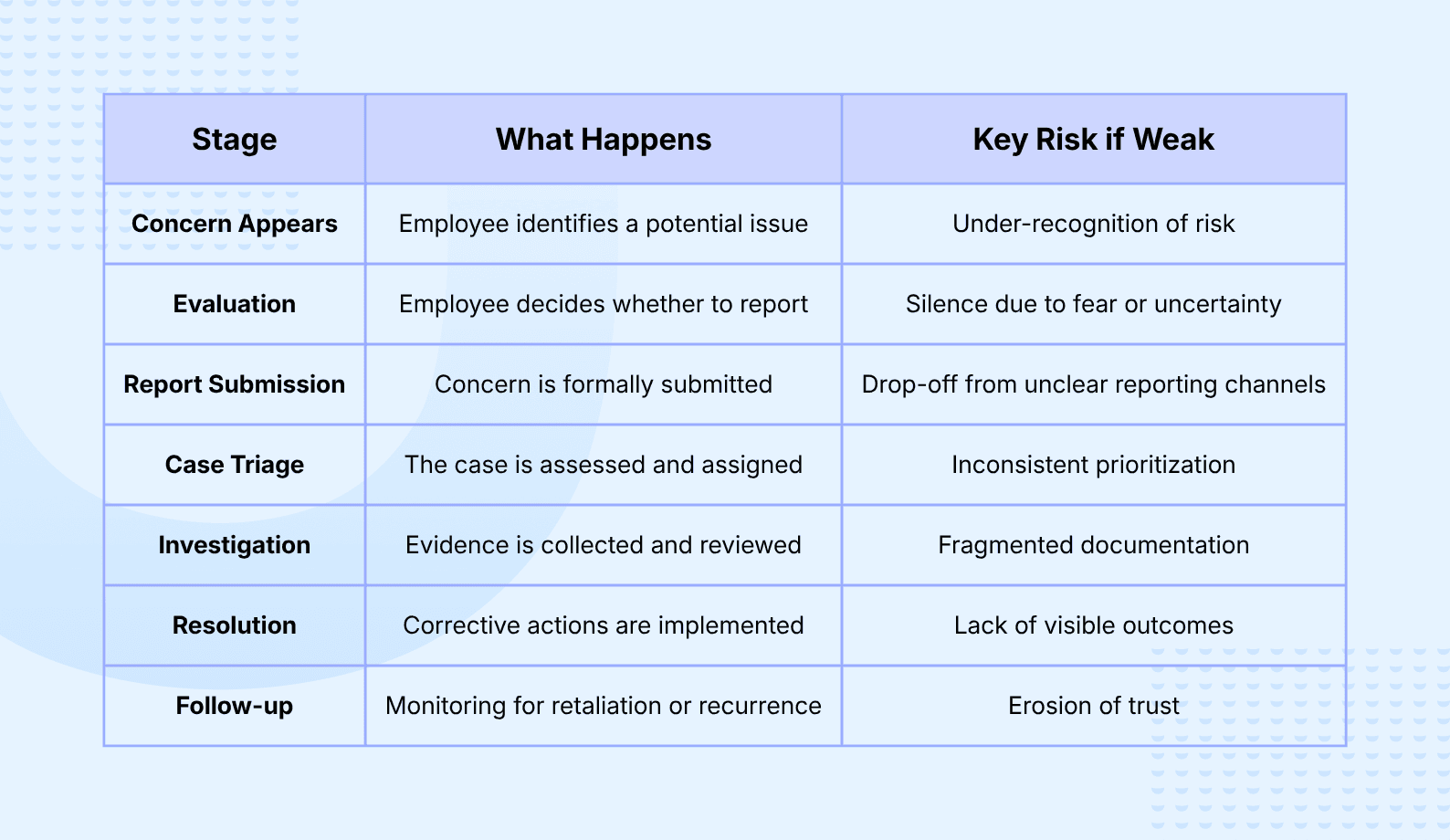
Once a report enters the system, organizations need consistent handling based on issue type.
Situation | What Employees Notice | Recommended Handling | Risk if Mishandled |
|---|---|---|---|
Harassment / Discrimination | Repeated inappropriate behavior | Formal investigation + protection measures | Legal exposure and trust loss |
Financial Irregularities | Unusual approvals or spending | Compliance escalation + audit review | Fraud escalation |
Safety Violations | Unsafe shortcuts or ignored protocols | Immediate operational + compliance review | Injury and regulatory penalties |
Retaliation Concerns | Negative treatment after reporting | HR/compliance investigation + monitoring | Silence culture |
Policy Violations | Repeated process bypassing | Enforcement and correction | Control breakdown |
Data Privacy Issues | Improper access or handling | Security + compliance escalation | Regulatory breach |
Conflict of Interest | Undisclosed relationships | Disclosure review process | Reputational risk |
The effectiveness of whistleblowing depends on alignment across all three layers:
When one layer breaks down, the entire system becomes weaker. The issue in most organizations isn’t a lack of reporting tools, but a lack of alignment between how these layers are meant to work and how they actually operate.
Want to use this internally?
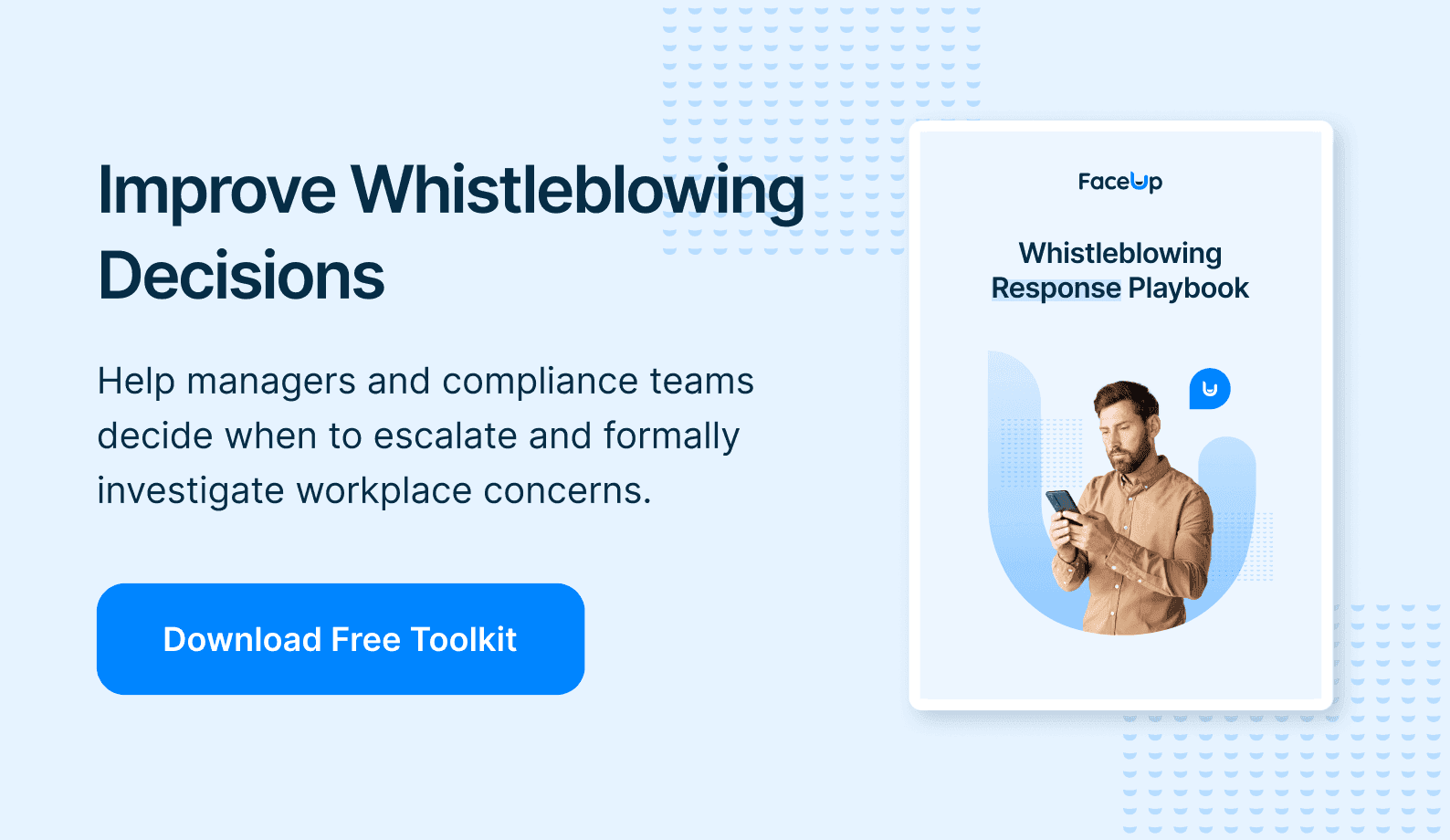
FaceUp’s Whistleblowing Response Playbook helps managers and compliance teams respond to workplace concerns earlier, handle escalation more consistently, and strengthen reporting integrity across the organization.
Scenario | Immediate Actions | When to Escalate | Response Guide |
|---|---|---|---|
Employee excluded after submitting a report |
|
| COMMON FAILURES: Assuming retaliation only means termination or demotion. LEADERSHIP DISCUSSION: Would reporting discourage future whistleblowing in your organization? |
The complete playbook includes 7+ whistleblowing scenarios, escalation workflows, and investigation guidance designed to help managers and compliance teams respond earlier and more consistently.
Even organizations with strong cultures need structured systems behind reporting.
Employees hesitate when processes are unclear. At the same time, HR and compliance teams often rely on fragmented tools such as spreadsheets, email chains, and manual tracking. This creates inconsistent handling and weak traceability.
A modern reporting system like FaceUp helps organizations:
FaceUp brings reporting, investigation, escalation, and analytics into one system designed for compliance teams. This reduces friction across the entire lifecycle from report to resolution.
Organizations that handle whistleblowing well usually approach it as an operational discipline, not simply a legal requirement.
Employees and managers need clarity on:
Without this clarity, reporting becomes inconsistent and delayed.
Consistency is one of the strongest drivers of trust in reporting systems.
Organizations should rely on:
When similar cases are handled differently across teams or seniority levels, trust in the system declines quickly.
Managers are often the first point of contact for concerns.
Without proper training, they may:
Many reporting failures begin here, before compliance teams are even involved.
Monitoring should continue after investigations close.
This includes tracking:
Employees quickly notice whether speaking up leads to negative consequences.
Low reporting volume is not always a positive signal.
It may indicate:
The goal isn’t more reports. It’s an earlier and safer reporting of real issues.
Whistleblowing is now part of core compliance infrastructure, not a standalone reporting function. For leadership and boards, reporting systems provide early visibility into:
The value isn’t in how many reports are submitted, but in the quality and timing of risk signals.
Organizations that act on early signals are often able to contain issues before they escalate into:
Those that don’t typically discover the same issues later through external audits, regulators, or litigation, when remediation costs are significantly higher.
Assess your reporting maturity with our Risk Assessment & Engagement Checklist.
Most workplace issues are visible internally long before they become external problems. The difference is whether employees trust the reporting system enough to act early.
Strong systems surface risk earlier and prevent escalation. This only works when reporting, investigation, and accountability operate consistently in practice.
FaceUp helps organizations centralize reporting and case management in one secure platform built for modern compliance teams.
Book a demo to see how FaceUp helps detect and resolve issues earlier.
*This post was updated on 21/05/2026.
We’ll assess your needs and recommend the right setup for anonymous reporting or surveys - aligned with your compliance or HR goals.
Keep Reading
Marie Roland2026-07-275 min
Legal & Compliance
Marie Roland2026-07-276 min
Legal & Compliance
Alaa El-Shaarawi2026-07-2111 min
Legal & Compliance

Alaa El-Shaarawi2026-07-2111 min
Legal & Compliance